
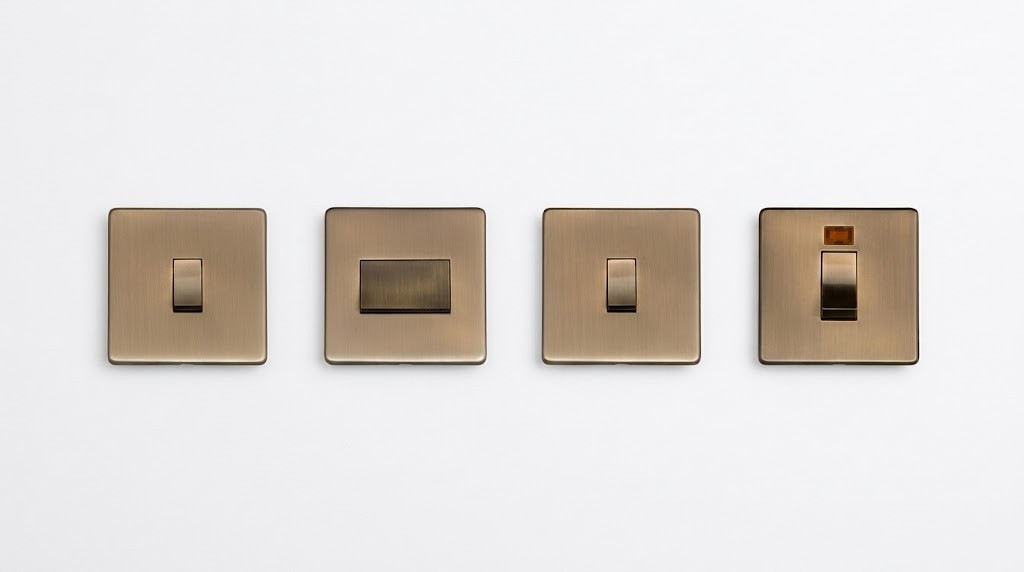
Rocker, Intermediate, Fan Isolator and Cooker Switches Explained: What Does Each One Do?
Electrical switches can look very similar on the wall while doing very different jobs. Much of the confusion comes from product names combining terms such as rocker, 2-way, intermediate, 3-pole and 45A, even though each describes a different characteristic.
The useful starting point is therefore not the finish or even the shape of the switch. First establish what needs to be controlled, from how many positions, and whether the accessory needs to provide isolation for a fan or appliance. For those already decided on aesthetics, our range of designer sockets and switches covers a wide choice of finishes and styles
Once that is clear, choosing the style and finish becomes much easier.
Key points
terms being mistaken for the same thing. These are the distinctions that matter most when choosing between common rocker, intermediate, fan and cooker switches.
- Two switches do not mean an intermediate switch: In a conventional arrangement, two control positions use two 2-way switches. Intermediate switches are introduced when there are three or more control positions.
- Staircases and landings create much of the confusion: These are common situations where customers need to work out whether they have two control positions or a multi-position arrangement requiring intermediate switching.
- Fan control and fan isolation are different functions: A 3-pole isolator used with many timer-fan arrangements can disconnect permanent line (often called permanent live), switched line and neutral together.
- 45A is a rating, not a universal cooker specification: The appliance and circuit still need to be considered before the switch requirement is confirmed.
- Gang, way, pole and amp rating describe different things: Reading each term separately makes switch specifications much easier to understand.
- Function should be decided before finish: Once the correct accessory type is known, decorative ranges and finishes can be compared without risking a visually suitable but electrically incorrect choice.
The Bottom Line: Choose the switch by function first. Count lighting control positions, confirm the required fan or cooker isolation and circuit specification, then choose the gang count, plate style and finish.
Quick comparison: which switch does what?
The quickest way to narrow down the options is to start with the job the accessory needs to perform. The table below gives the main buying cue for each type before we look at the differences in more detail.
| Switch type | What it does | Typical situation | Main question to ask |
| 2-way rocker switch | Lets the same light be controlled from two positions | Top and bottom of stairs, opposite ends of a hallway, two entrances to a room | Do I need to control this light from two positions? |
| Intermediate switch | Adds a third or further control position between two 2-way switches | Staircases, landings and longer circulation spaces | Do I need to control the same light from three or more positions? |
| 3-pole fan isolator | Lets the fan supply be disconnected for maintenance | Extractor fans, particularly timer or overrun arrangements | What isolation arrangement does the fan and circuit require? |
| 45A cooker switch | Provides switching and isolation for a cooker circuit | Electric cooker or oven circuits where this type of switch has been specified | What switch rating and configuration has been specified for the circuit? |
Gang, way, pole and amp rating: what do the terms mean?
Product descriptions become much easier to understand once these four terms are separated. A 2-gang 2-way rocker, a double-pole switch and a 45A cooker switch describe different characteristics, not different versions of the same measurement.
Each term answers a different question about the accessory.
| Term | What it describes | Simple example |
| Gang | How many individual controls are grouped on the accessory plate | A 2-gang rocker has two rocker controls |
| Way | The lighting switching function the switch can form part of | A 2-way switch can form part of a two-position lighting arrangement |
| Pole | How many conductors the switching device operates together | A double-pole switch operates two; a 3-pole isolator operates three |
| Amp rating | The current rating of the accessory | A cooker switch may carry a 45A rating |
The practical lesson is not to select a product because one number in its description appears to match something you have been told.
If an electrician specifies an accessory, ask for the complete requirement: function, gang count where relevant, switching type, pole configuration and rating.
A rocker describes the switch style, not the whole function
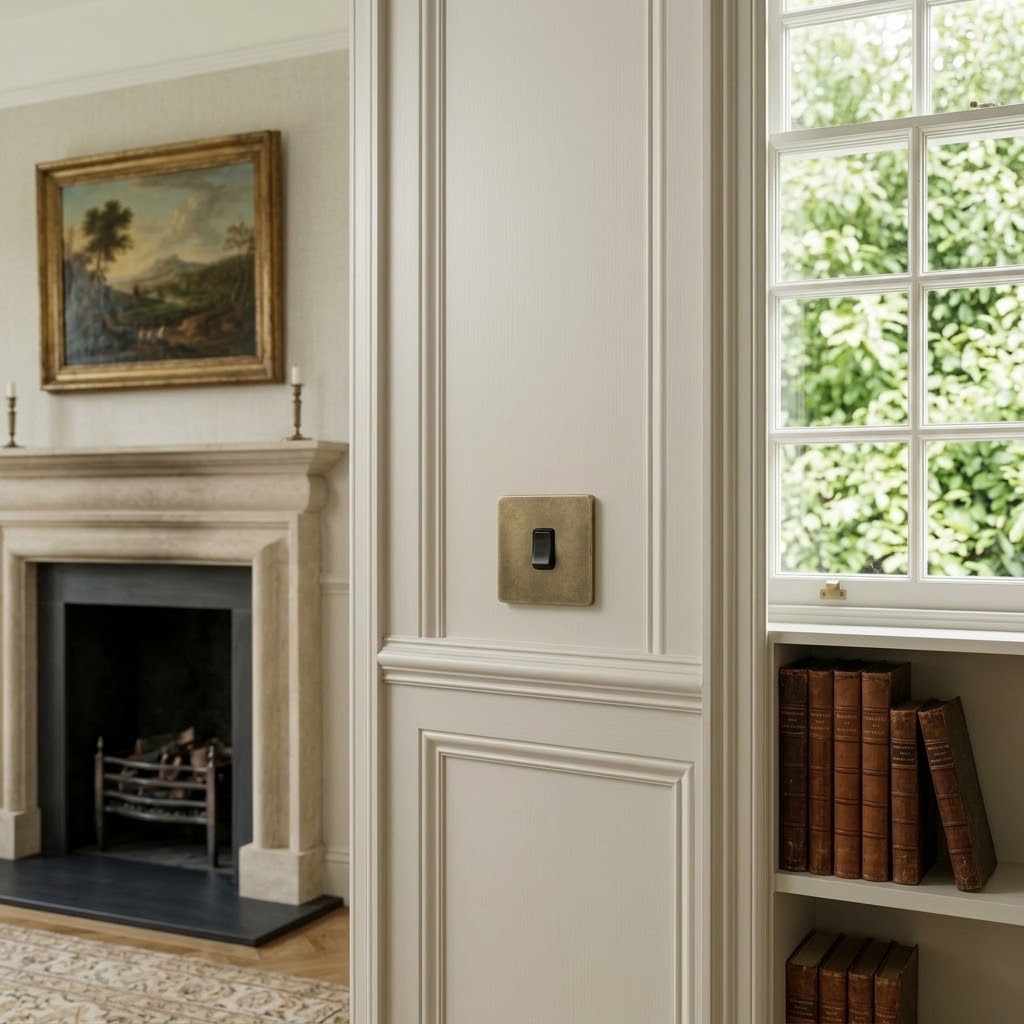
A rocker switch is named after the part you press, which rocks from one position to another. Knowing that you want a rocker therefore does not yet tell you whether you need a 1-way, 2-way or intermediate switch.
That distinction explains why two products can look almost identical from the front but not be interchangeable.
A switch described as a 1-gang 2-way rocker, for example, contains one rocker control on the plate and has a 2-way switching function.
A 2-gang version contains two individual rocker controls. Those controls may operate separate lighting circuits depending on how the installation has been designed.
Among Arrow Electricals’ customers, 1-gang and 2-gang rocker switches are the strongest sellers within this part of the range, with 2-way versions particularly popular.
Once the required function is known, the wider rocker switch range can be compared by gang count, plate style and finish.
2-way or intermediate switch: which one do you need?
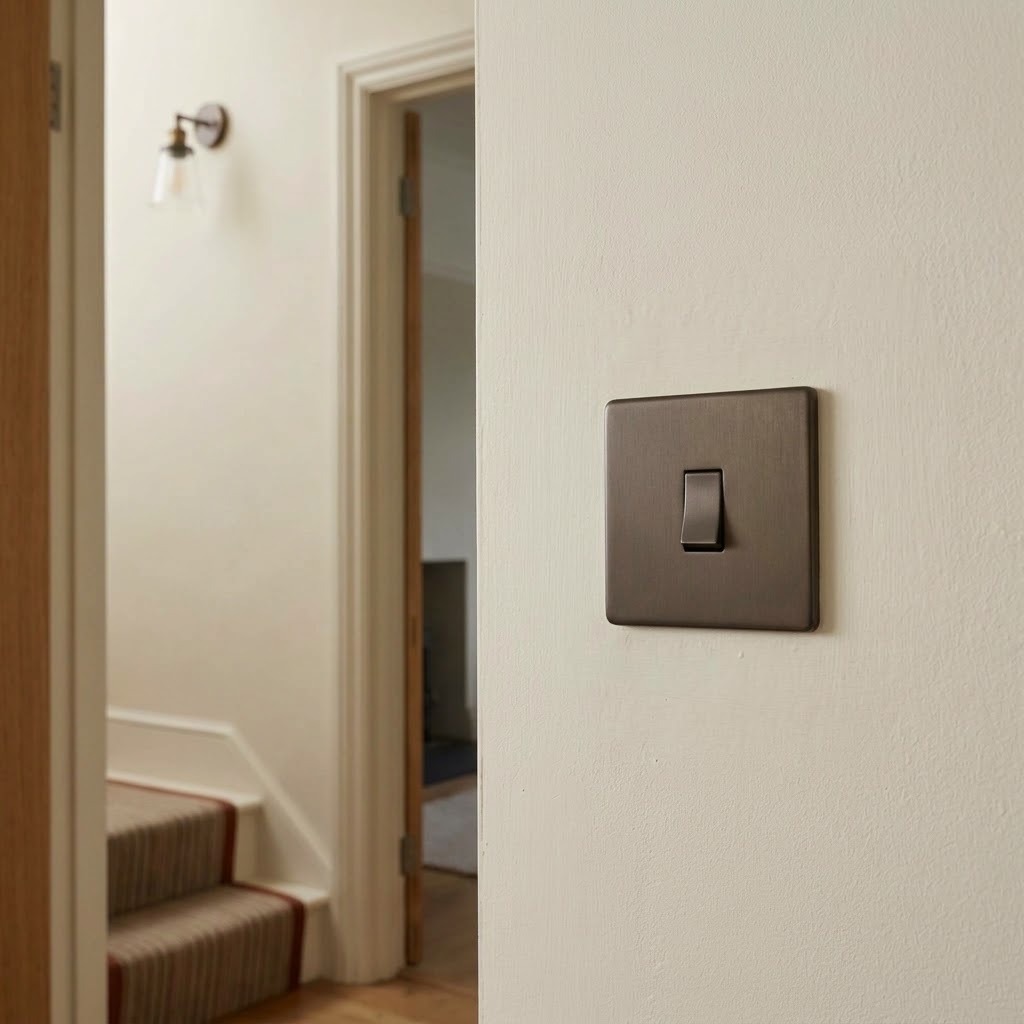
This is one of the questions that causes the most customer confusion. The deciding factor is the number of separate positions from which you want to control the same light.
For a conventional switching arrangement, this is the simplest way to think about it.
| Control positions | Typical arrangement | Example |
| 1 | 1-way switching | One switch controlling the light from one position |
| 2 | Two 2-way switches | One switch at the bottom of the stairs and one at the top |
| 3 | 2-way switch + intermediate switch + 2-way switch | Bottom of stairs, top of stairs and another point on the landing |
| 4 or more | 2-way switches at the ends with additional intermediate switches between them | Longer hallways or circulation areas with several control points |
Why two switches do not mean “intermediate”
A recurring Arrow Electricals customer enquiry is whether an intermediate switch is required as soon as two switches operate the same light.
In a conventional two-position arrangement, the two end switches are both 2-way switches.
A staircase with one switch downstairs and one upstairs therefore uses 2-way switching at both ends, without an intermediate switch.
When does an intermediate switch come into the arrangement?
An intermediate switch becomes relevant when another control position is added between the two ends of the switching arrangement. Internally, it changes the connections between the two pairs of switching conductors, allowing the extra control point to sit between the two 2-way switches.
For three control positions, a 2-way switch sits at either end with an intermediate switch between them. Further intermediate switches can be added between the end switches when more control positions are required.
A typical example would be one switch downstairs, another at the top of the stairs and a third further along the landing.
For three or more control positions, intermediate rocker switches are the type to compare once the switching arrangement has been confirmed.
Before ordering, count the control positions and ask a competent electrician to confirm the required switch types.
What does a fan isolator switch do?
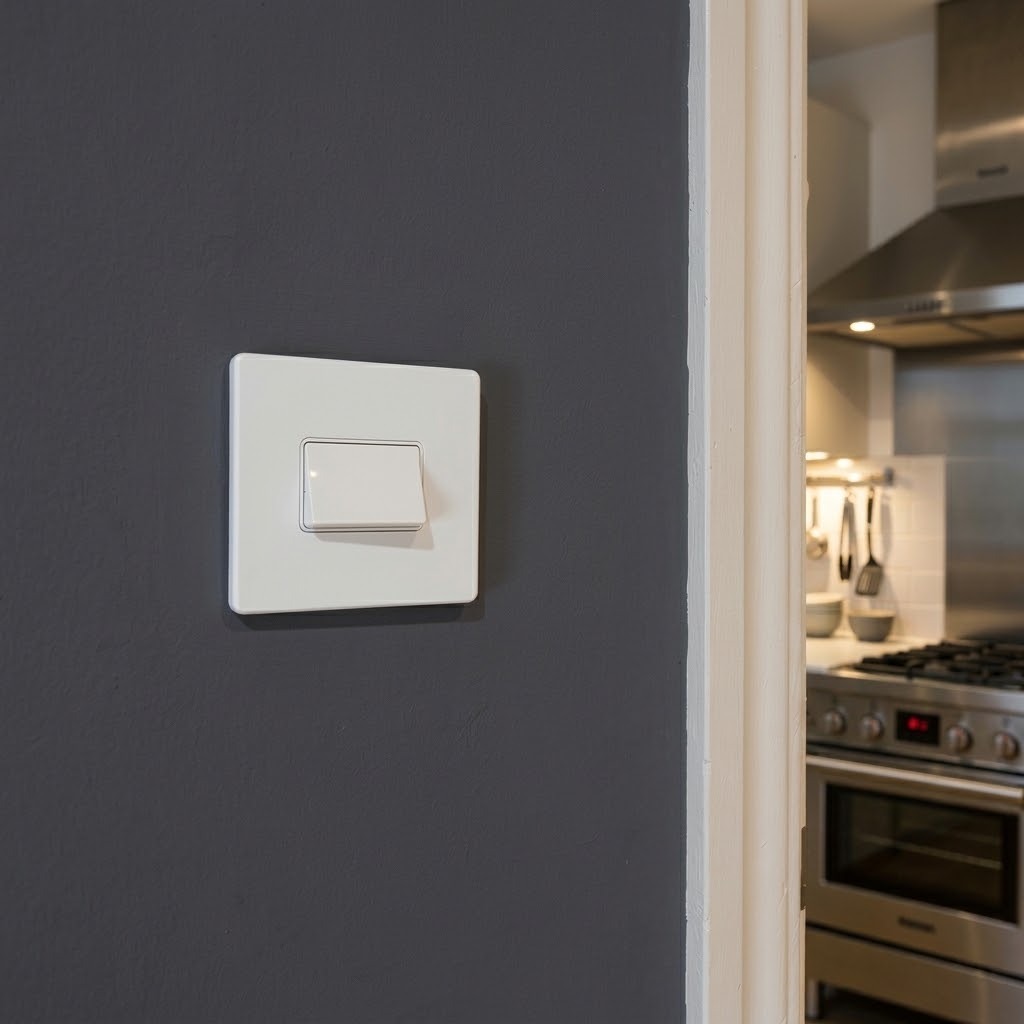
A fan isolator lets the electrical supply to a fixed fan be disconnected for maintenance. That is different from the everyday control that tells the fan when to start, stop or respond to another trigger.
This difference is particularly relevant to extractor fans with timer or overrun functions, which may continue operating after the room light has been switched off.
Is a fan isolator the same as a normal fan switch?
No. They describe different functions.
A fan control is concerned with how the fan operates. Depending on the installation, the fan might be triggered by a light switch, timer, humidity sensor or another control.
An isolator is concerned with disconnecting the relevant supply for maintenance.
The two functions can therefore exist within the same fan installation without being performed by the same accessory.
Why are many fan isolators 3-pole?
Many timer or overrun extractor-fan arrangements use permanent line, switched line and neutral conductors.
A 3-pole fan isolator can disconnect those three conductors together.
This is why a 3-pole fan isolator is different from an ordinary lighting switch, even if both products look like relatively simple wall accessories from the outside.
Fan isolator switches are available within Heritage Brass decorative ranges, allowing the isolator to coordinate visually with surrounding switches and sockets.
Relevant fan isolating switches can then be compared once the installation requirement has been established.
Do all extractor fans need a 3-pole isolator?
A fixed extractor fan needs a means of isolation for maintenance, but that does not mean every fan installation requires the same 3-pole accessory.
The isolation arrangement depends on the fan, its controls, the manufacturer’s instructions and the way the circuit has been designed.
For a timer or overrun fan using permanent line, switched line and neutral, a 3-pole isolator is a common solution. A competent electrician should confirm what the particular installation requires before the accessory is selected.
What does a 45A cooker switch do?

A cooker switch provides switching and isolation for a cooker circuit. Although it may use a rocker-style mechanism, its function and rating are very different from an ordinary lighting rocker.
Within the Heritage Brass ranges, 45A double-pole cooker switches are a common format and can be coordinated with other visible electrical accessories once the required specification has been confirmed.
The 45A cooker switches category includes Heritage Brass options in a range of finishes.
What does 45A mean on a cooker switch?
The 45A figure is the current rating of the switch.
It is one part of the product specification, not a statement that every appliance should be connected through a 45A switch.
What does double pole mean?
A double-pole, or DP, switch operates two conductors together.
This is another example of why the numbers and abbreviations on an accessory should be read separately. “45A” tells you about its current rating, while “double pole” describes the switching arrangement within the accessory.
Does a 45A cooker switch suit every cooker?
No.
Whether a particular switch is suitable depends on the appliance requirements and the circuit as a whole, including the protective device, cable selection and designed load.
A 45A switch can be the correct choice where it has been specified for the circuit, but 45A should not be treated as a universal cooker-switch specification.
If the appliance is already known, give its electrical information to the competent electrician before ordering the visible accessory.
Cooker switch, cooker control unit and cooker connection point
Cooker terminology is less consistent than many customers expect. Different manufacturers and retailers can use similar terms for accessories that do not contain the same features.
The safest approach is therefore to check what the product actually does rather than choosing from the name or the abbreviation “CCU” alone.
| Term you may see | What it commonly describes | What to check |
| Cooker switch | An accessible high-current switch providing switching and isolation | Current rating, pole configuration and circuit requirement |
| Cooker control unit | A cooker switching accessory that may also incorporate a 13A socket | Exactly which functions and outlets the product contains |
| Cooker outlet or connection plate | A fixed termination point used to connect the appliance to the installation | Whether this is the connection accessory specified for the installation |
| Cooker connection unit / CCU | Terminology varies between manufacturers and retailers | Do not rely on the name alone; check the product specification and function |
A cooker installation can therefore contain more than one accessory doing different jobs. The accessible cooker switch and the final connection point near the appliance are not necessarily the same component.
Before ordering, establish whether you need the switch, the appliance connection point, a combined control unit, or more than one of these.
Before you order: what else to check
Correct function is only part of the order. Physical fit, location and accessory features can also determine whether a switch is suitable for the planned installation.
- Back-box depth: Check the minimum box depth for the exact model. Intermediate switches vary by range, while 45A cooker switches can need substantially more space than a standard lighting switch.
- Indicator: Some cooker switches include a neon indicator, and others do not. Decide whether a visible on/off indication is wanted before choosing the plate.
- Bathroom location and IP suitability: Do not assume a decorative fan isolator can be fitted anywhere in a bathroom. Bathroom zones, the accessory’s IP suitability and the fan manufacturer’s instructions affect where equipment can be installed; fan isolators are often positioned outside the room.
- Plate style: Check whether the surrounding accessories use screwed or screwless plates and whether the new switch comes from the same decorative range.
- Wiring and terminal space: Multi-way and higher-current accessories can require more conductors or larger cables behind the plate. The electrician should confirm that the terminals and available box space suit the circuit.
These checks are especially useful when replacing an existing accessory, because a plate that looks right from the front may not fit the existing back box or wiring arrangement.
Building Regulations: BS 7671 (the IET Wiring Regulations) is the UK national standard for electrical installations and applies across England, Wales, Scotland and Northern Ireland. All work should comply with it. Whether specific work must also be notified to building control — and how — varies by location and work type. A registered electrician can confirm what applies to your installation.
Choose the function before the finish
Once the electrical function is established, the decorative choice becomes much simpler. Two switches can share the same plate design and finish while performing very different jobs internally.
Arrow Electricals own sales data shows that Antique Brass and Matt Bronze are the strongest-selling Studio Range finishes. In the Vintage Range, Matt White leads, with Polished Brass and Satin Nickel also among the more popular choices.
The useful order is therefore to identify the correct accessory first and then choose the finish within that product type.
For a deeper look at coordinating visible electrical accessories, see our guide to choosing designer socket and switch finishes.
Rocker, intermediate, fan isolator and cooker switch FAQs
Most ordering mistakes become easier to avoid once the function of the accessory is separated from its appearance. These final questions address a few common situations that customers may still encounter.
Can a 2-way switch be used as a 1-way switch?
Often, yes. Many 2-way switches are designed so they can also be used in a 1-way arrangement.
Check the individual product specification rather than assuming every switch is configured in the same way.
Can you use more than one intermediate switch?
Yes, where the circuit has been designed for additional switching positions.
A conventional multi-position arrangement can use 2-way switches at the two ends with more than one intermediate switch between them.
Is a fan isolator meant to be the normal on/off control for the fan?
Its main purpose is isolation rather than everyday fan control.
How the fan normally operates may instead depend on a light switch, timer, humidity sensor or another control arrangement.
Does 45A mean a cooker switch will work with any electric cooker?
No. It tells you the current rating of the switch.
The appliance requirements and the design of the circuit still need to be considered before the switch specification is confirmed.
Is the cooker switch the same as the cooker outlet behind the appliance?
Not necessarily.
The accessible cooker switch provides switching and isolation, while a separate outlet or connection plate may provide the final fixed connection to the appliance. Because cooker terminology varies between manufacturers, always check the function shown in the product specification.
Getting the order right
Switch terminology becomes much easier once you treat each label as separate information.
For lighting, first count the number of places from which the light needs to be controlled. Two positions normally use 2-way switches, while three or more positions introduce intermediate switching.
For fans and cookers, focus instead on the required isolation, pole configuration and electrical rating. Terms such as 3-pole, double pole and 45A describe different characteristics and should not be treated as interchangeable indications of suitability.
Once the functional requirement is confirmed, the final decision becomes much simpler: choose the correct accessory type, then select the gang count, plate style, and finish that suit the room.
Recent Posts
-
Rocker, Intermediate, Fan Isolator and Cooker Switches Explained: What Does Each One Do?
Electrical switches can look very similar on the wall while doing very different jobs. Much of the …22nd Sep 2026 -

How Many Downlights Do You Need? Plan the Layout Before You Install
Downlights are often arranged on a ceiling before anyone has asked the most important question: what …10th Sep 2026 -

Door Locks and Latches Explained: Which Type Does Your Door Need?
Choosing a door handle is usually straightforward because you can see the style, shape and finish. …28th Aug 2026