
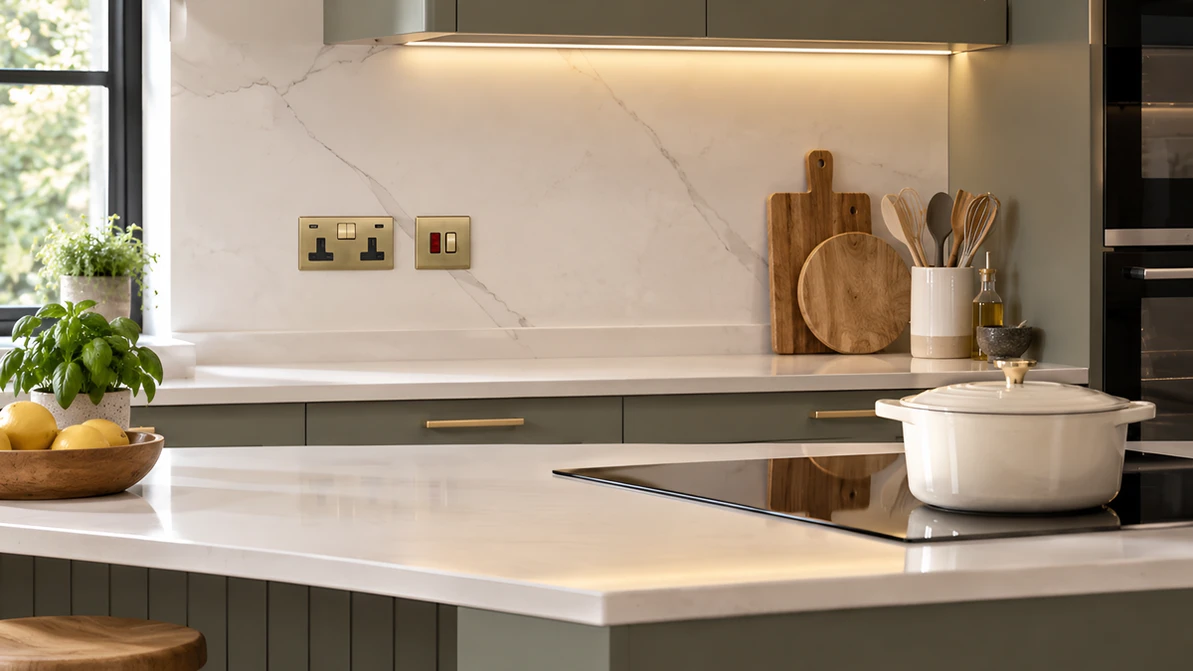
Screwless & Flat Plate Switches: What to Check Before You Choose
A new switch plate can look perfect in a photograph but turn out to be wrong for the wall it’s going on. The finish might match your door handles, the profile might be exactly what you wanted, yet the mechanism behind it needs more space than your existing backbox provides.
It’s a detail that’s easily missed when choosing designer sockets and switches, particularly if you’re replacing older fittings.
You’ll also come across descriptions such as screwless, flat plate and low profile. These aren’t different names for the same thing. Each describes a particular feature, and understanding the distinction makes choosing suitable replacements much easier.
Key Points
Appearance is usually what draws people towards decorative switches and sockets. Arrow Electrical’s customer feedback highlights why it’s worth looking beyond the faceplate before making a decision.
- Screwless doesn’t necessarily mean flat plate. One describes concealed fixings, the other the plate’s profile. A switch can have both features.
- Backbox depth is easily overlooked. Arrow’s team encounters customers who haven’t considered the space behind their existing accessories before choosing replacements.
- Matching accessories may have different fitting requirements. A rocker switch might need a 25mm backbox while a socket or dimmer from the same range requires 35mm or more.
- Finish preferences vary with the project. Arrow’s staff report strong interest in screwless designs and highlight Matt Bronze and Antique Brass among customer’s preferred finishes.
- Renovation buyers often want a coordinated look. Choosing matching plates is simpler when the full range and its individual specifications are checked before ordering.
What do screwless, flat plate and low profile actually mean?
These descriptions refer to different characteristics of a switch or socket. They’re often used together in product listings, which can make the distinction less obvious than it should be.
A screwless fitting conceals the fixing screws behind a decorative front plate. Flat plate and low profile describe how the finished accessory sits against the wall.
| Description | What it means | What to consider |
| Screwless | A front plate conceals the fixing screws | How the cover attaches and the product’s fitting requirements |
| Flat plate | A slim, relatively flat faceplate | Wall condition, dimensions and box depth |
| Low profile | A design with relatively little visible projection | The actual plate profile and space needed behind it |
| Visible-screw plate | Fixing screws remain visible on the finished faceplate | Appearance, dimensions and compatibility |
A screwless switch still uses screws to secure its main assembly. The difference is that a separate cover conceals them once the accessory is installed.
Flat plates can have either concealed or visible fixings. Likewise, a low-profile design doesn’t tell you how deep the switch mechanism extends into the wall.
Which plate design will suit your room?
Screwless designs are attractive when you want a clean, uninterrupted appearance. Without visible fixing screws, the finish and shape of the plate become the main details.
Flat plate designs create a similarly restrained effect, sitting visually close to the wall. They can look particularly neat in contemporary rooms with smooth plaster and simple architectural details.
That last point is worth considering in older properties.
A very flat plate can make uneven plaster more apparent, especially where the wall surface dips or rises around the backbox. A slightly raised or more decorative plate may be more forgiving.
Traditional interiors can also benefit from a little more detail. The Georgian Elite range, for example, uses a decorative rope-edge design that works naturally with period-style fittings and finishes.
Of course, there’s no requirement to match a switch plate to the age of the building. A modern screwless design can provide an attractive contrast in an older home, while a traditional brass plate can add character to a contemporary room.
What’s more useful is considering how the plates relate to the surrounding details. Door handles, cabinet hardware, lighting and wall colour will all influence how the chosen finish looks once installed.
Will your existing backbox be deep enough?
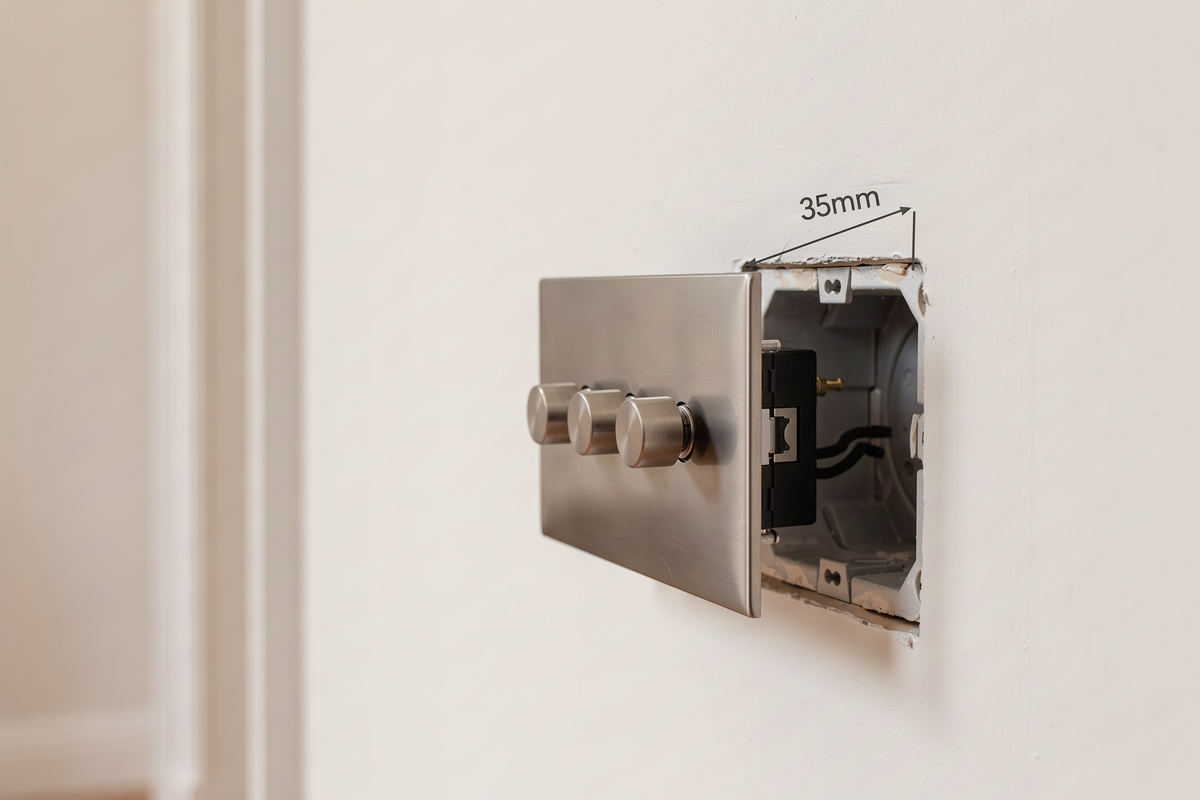
This is one of the most important checks when replacing switches and sockets.
The backbox is the enclosure behind the accessory, usually recessed into the wall. It provides space for the mechanism and electrical connections.
If the existing box is shallower than the new accessory requires, fitting the replacement may involve more work than expected.
Why a matching range doesn’t guarantee a matching depth
Consider the Heritage Brass Winchester range in Matt Bronze.
Arrow Electrical’s currently lists the 1-gang rocker switch with a minimum box depth of 25mm.
The matching 13A double socket requires 35mm. A cooker unit incorporating a 13A socket from the same range specifies 48mm.
Imagine updating a finished kitchen with Matt Bronze throughout. The rocker switches might suit your existing 25mm boxes, but that doesn’t mean the matching sockets will fit.
It’s an easy detail to miss when you’re choosing from photographs.
The finish may match, but the fitting requirements won’t necessarily be the same. Check each accessory’s specification before ordering.
What if your existing backbox is too shallow?
You may still be able to achieve the appearance you want without major changes.
Another product in the chosen range could have a shallower minimum requirement. Alternatively, a different range might offer a similar finish and profile with dimensions better suited to the existing installation.
If a deeper backbox is needed, an electrician can assess whether replacing it is practical, taking account of the wall construction and existing installation.
It’s also important to remember that the minimum box depth is only one part of compatibility. The space available for wiring, the condition of the existing fittings and the manufacturer’s requirements all need consideration.
For a straightforward replacement, finding a suitable accessory for the existing installation may be preferable to altering an otherwise finished wall.
Replacing one switch or updating the whole room?
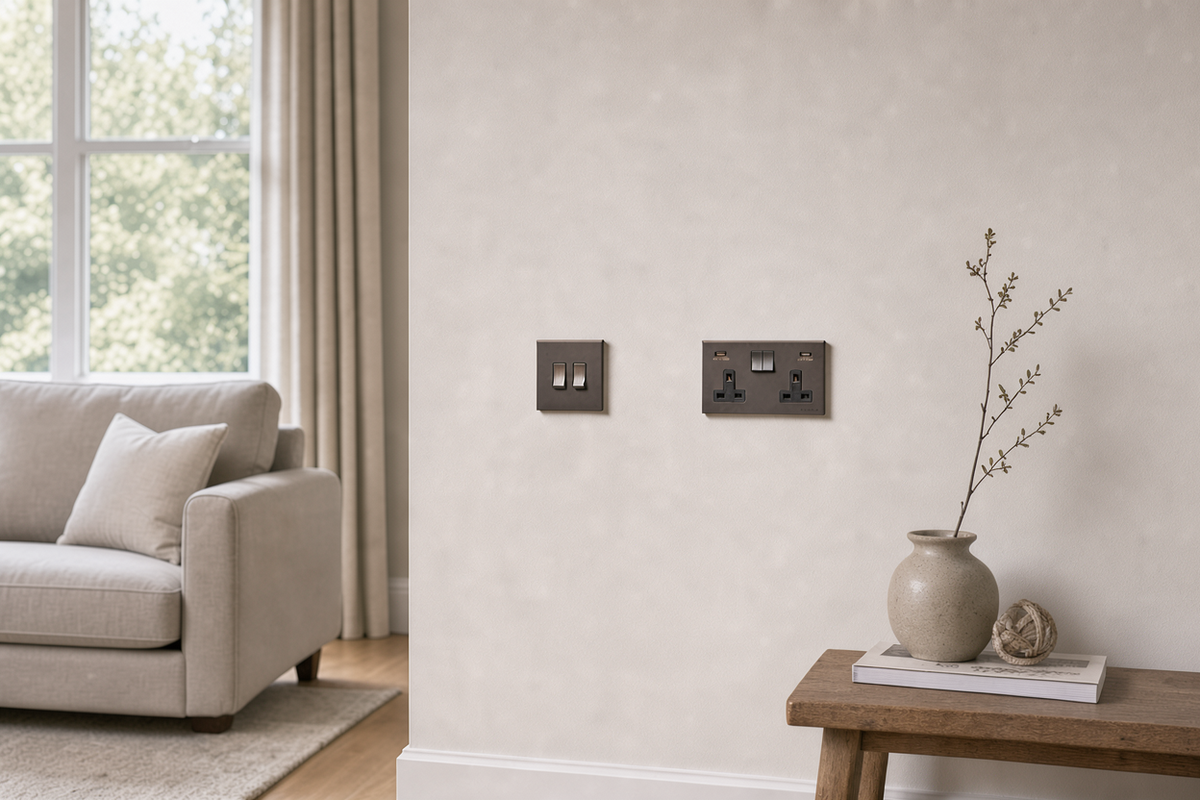
The scale of the project changes what you need to plan.
If you’re replacing a single switch, the priority is usually to find something compatible with the existing electrical function, backbox and surrounding accessories. You may also want it to blend in with the plates you’re keeping.
A full renovation gives you more freedom to establish a consistent design.
Arrow’s team reports that customers undertaking larger interior projects often order coordinated sets of switches and sockets. That makes sense visually, but the chosen range also needs to include all the functions required around the room.
A matching rocker switch and double socket may be easy to find. The challenge can come when you also need dimmers, cooker controls, data connections or other specialist accessories.
Not every finish or configuration is necessarily available across the complete collection. It’s worth making a list of everything you need before committing to a particular design.
The Elite Flat Plate range provides one example of a coordinated decorative collection with different accessory types. Checking the complete range at the planning stage can save disappointment when you come to order the less common fittings.
For wider guidance on positioning sockets, selecting features and planning a renovation, see our guide to switches and sockets for renovations.
Six things to check before ordering
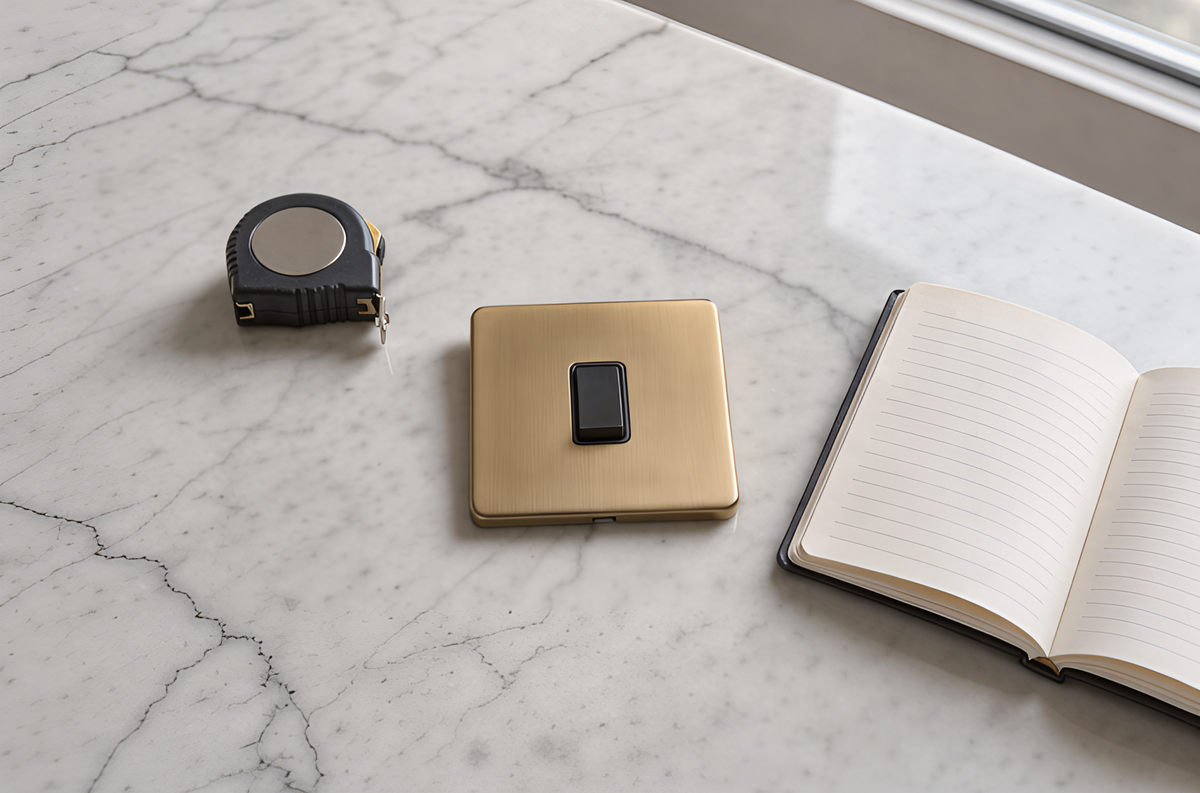
A decorative switch or socket should look right and work with the installation behind it. Before placing an order, these checks will help avoid the most common oversights.
- Know your existing backbox depth. Ask your electrician to confirm the available depth and compare it with the minimum specified for each new accessory. Don’t assume every fitting in a matching range needs the same space.
- Check the dimensions of the faceplate. Look at its height, width and visible projection, especially when replacing older accessories. A different plate size or profile may reveal imperfections in the surrounding plaster.
- Confirm the electrical function. Check the required number of gangs and whether each switch needs one-way, two-way or intermediate functionality. Dimmers and specialist controls need their own compatibility checks.
- Make sure the complete range works for your room. List every required switch, socket, dimmer and control before ordering. Check that the chosen finish and configuration are available for each one.
- Look at finishes in context. Matt Bronze, Antique Brass and other metallic finishes can appear different under natural and artificial lighting. Consider wall colours and nearby metalwork before committing to a room-wide scheme.
- Have the installation checked. The condition of the existing wiring, available space, earthing arrangements and manufacturer’s instructions all matter. A competent electrician should confirm suitability and undertake the electrical work.
If you’re renovating, agreeing the complete accessory list with your electrician before decorating can prevent avoidable changes later.
Frequently Asked Questions
A few practical questions tend to arise once you’ve chosen a style, particularly when the existing accessories are being replaced rather than installed as part of a new project.
Can I change just the screwless faceplate to another finish?
Sometimes, provided the manufacturer offers a compatible replacement cover for that particular accessory. Screwless faceplates aren’t necessarily interchangeable between ranges or manufacturers, even when they look similar. Check the exact product reference and manufacturer’s instructions before ordering a replacement cover.
Do screwless switches always require a 35mm backbox?
No. Some screwless models are specified for 25mm backboxes, while others require 35mm or more. The correct depth depends on the individual product and its internal components.
Can I replace plastic switches with metal faceplates?
Often, but the existing installation must be suitable. Earthing arrangements are particularly important with metal accessories, and the new fitting must have the appropriate electrical function and dimensions. A competent electrician should assess the installation before replacement.
Do flat plate switches sit completely flush against the wall?
Not necessarily. Flat plate describes a relatively slim profile, but the plate still has physical thickness. How neatly it sits also depends on the wall surface, backbox position and manufacturer’s fitting requirements.
Choosing a finish that fits
There’s plenty of scope to make switches and sockets part of a considered interior, whether you prefer a simple screwless design, a slim flat plate or something more traditional.
The important thing is not to let the finish make the whole decision for you.
Check the exact accessories your room needs, confirm their dimensions and make sure they’re suitable for the existing installation. That way, the plates you choose will look as intended without creating unnecessary complications behind the wall.
Recent Posts
-

Screwless & Flat Plate Switches: What to Check Before You Choose
A new switch plate can look perfect in a photograph but turn out to be wrong for the wall it’s goin …31st Oct 2026 -

Alabaster Lighting: A Guide to Styling Alabaster Lights in UK Homes
Alabaster is a fine-grained, mineral-based natural stone prized for centuries in sculpture and arch …12th Oct 2026 -

What Bulbs Do Chandeliers Use? E14, Lumens, Colour Temperature and Dimming Explained
Choosing a chandelier is only part of the decision. The bulbs still need to fit properly, provide t …3rd Oct 2026