

Door Locks and Latches Explained: Which Type Does Your Door Need?
Choosing a door handle is usually straightforward because you can see the style, shape and finish. Choosing the mechanism behind it can be less obvious.
Tubular latches, sashlocks, bathroom locks, night latches, deadbolts and deadlocks perform different jobs, yet some of the names are easily confused. That becomes especially important when replacing existing hardware, because choosing the wrong size or mechanism can mean altering a door that did not otherwise need changing.
This guide focuses on the common mechanical locks and latches used with door handles, knobs and traditional timber doors rather than multipoint or smart-lock systems. It draws on manufacturer information alongside the questions, buying problems and sales patterns that repeatedly arise through Arrow Electricals’ customer enquiries.
The aim is to identify the mechanism that suits the door’s job and existing preparation before comparing finishes or placing the order.
Key points
The differences between locks and latches become much easier to understand once you separate the door’s function from the product terminology. These key points also highlight some of the recurring buying problems seen through Arrow Electricals customer enquiries.
- Tubular latches and sashlocks lead demand: They are the two strongest-selling product types within Arrow’s Locks & Latches category.
- Sizing is a recurring difficulty: Customers frequently know they need a latch but struggle to identify the correct case length and backset.
- Deadbolt and deadlock are commonly confused: The terms are often used interchangeably even though they do not describe exactly the same thing.
- Replacement measurements matter: Matching the dimensions of the existing mechanism can reduce the need for extra drilling or alterations to the door.
- Finish mismatch causes avoidable exchanges: The visible parts of a lock or latch need to coordinate with handles, knobs and surrounding hardware.
- Handles and mechanisms are separate decisions: Heritage Brass handles and knobs require the appropriate latch or lock to be selected separately.
The Bottom Line: Choose by function first, existing dimensions second and finish third.
Quick answer: which lock or latch do I need?
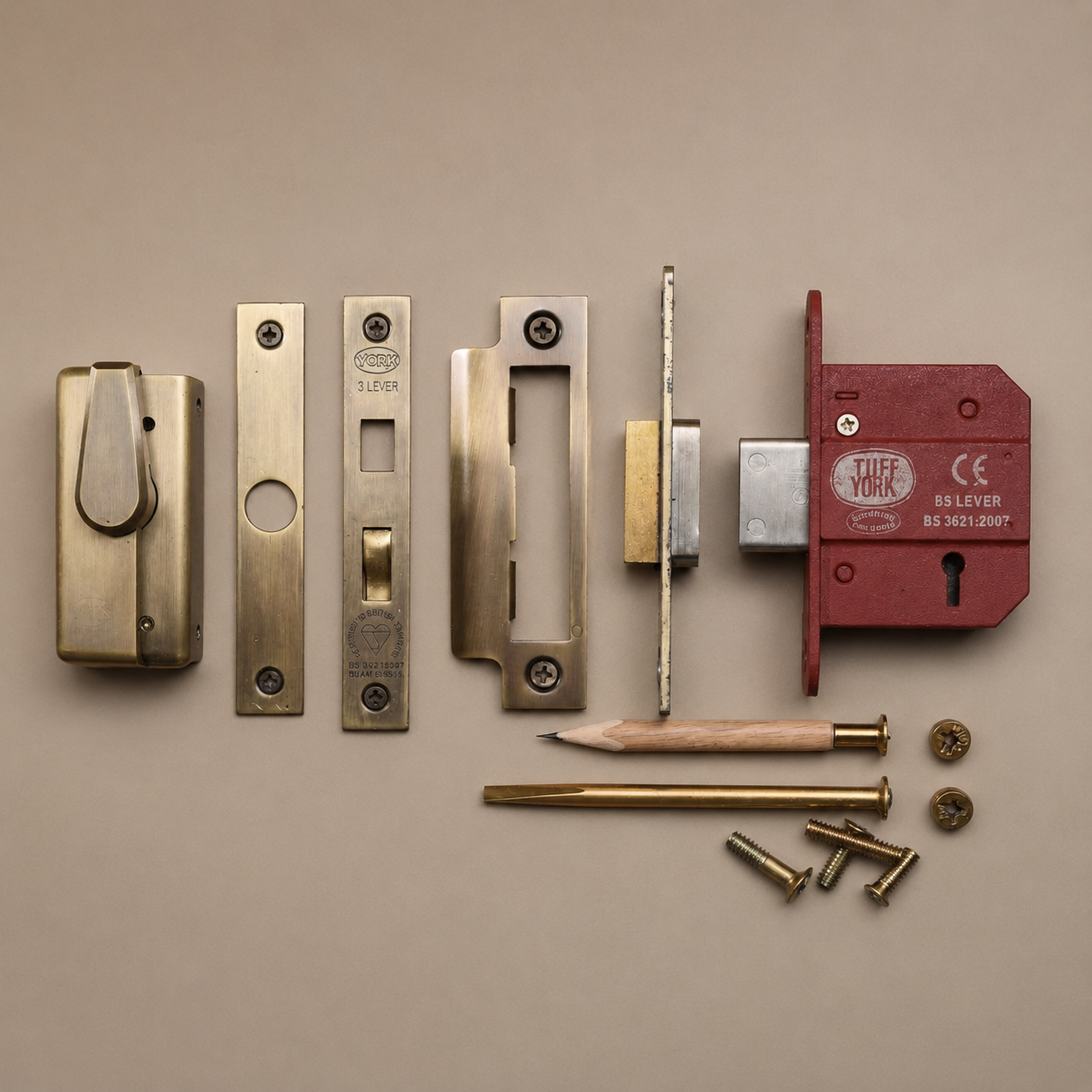
Different mechanisms suit different door functions. The table below provides a starting point, but the dimensions and individual product specifications still need to be checked.
| Door requirement | Typical starting point | What it does | Common buying issue |
| Standard internal door with handle or knob | Tubular latch | Holds the door closed without locking | Choosing the wrong case length or backset |
| Door using a handle that also needs locking | Sashlock | Combines a sprung latch and locking deadbolt | Matching the replacement dimensions |
| Bathroom or WC needing privacy | Bathroom lock | Combines normal latching with a privacy-locking function | Choosing the correct mechanism for the door furniture |
| Bathroom or WC using a separate privacy bolt | Tubular bathroom deadbolt used alongside a latch | Adds a separate privacy bolt while the latch operates the handle | Ensuring the turn, release and latch arrangement are compatible |
| Timber entrance door using a traditional rim-mounted lock | Rim night latch | Typically latches automatically when the door closes | Assuming all night latches provide the same security level |
| Door needing a separate locking point without a latch | Deadlock | Provides a locking deadbolt without a sprung latch | Confusing a deadlock with a deadbolt |
A sashlock contains both a sprung latch and a deadbolt, whereas a mortice deadlock contains the deadbolt without the latch. A tubular latch simply holds a door closed without providing the same locking function.
Start with what the door needs to do
The terminology becomes much easier once you stop looking at the lock first and look at the door instead.
Ask whether the door simply needs to close, needs privacy, needs key-operated security or forms part of an external entrance. The answer quickly narrows the choice.
For example:
- an ordinary living-room or bedroom door may only need a tubular latch;
- a bathroom needs normal closing plus privacy;
- an internal door that needs key locking may require a sashlock;
- an entrance door may use a night latch, mortice lock or another security arrangement depending on the door and required security level.
Door furniture and the mechanism behind it should therefore be considered together rather than as completely separate decisions.
Mortice vs rim: why the distinction matters
A mortice mechanism is fitted into a pocket cut into the edge of the door. Tubular latches, sashlocks, bathroom locks and mortice deadlocks are common examples.
A rim-mounted mechanism is fixed mainly to the surface of the door. The traditional domestic rim night latches discussed in this guide are an example.
The distinction matters when replacing existing hardware because changing from one format to another can require substantially different door preparation.
Where possible, identify what is already fitted before choosing the replacement.
What is a tubular latch?
A tubular latch is a spring-loaded mechanism that holds a door closed without locking it.
Turning the handle or knob retracts the latch so the door can open. Releasing it allows the latch to engage with the keep in the frame again.
Tubular latches are particularly popular for ordinary internal doors and are one of the strongest-selling types within Arrow’s Locks & Latches category.
What size tubular latch do I need?
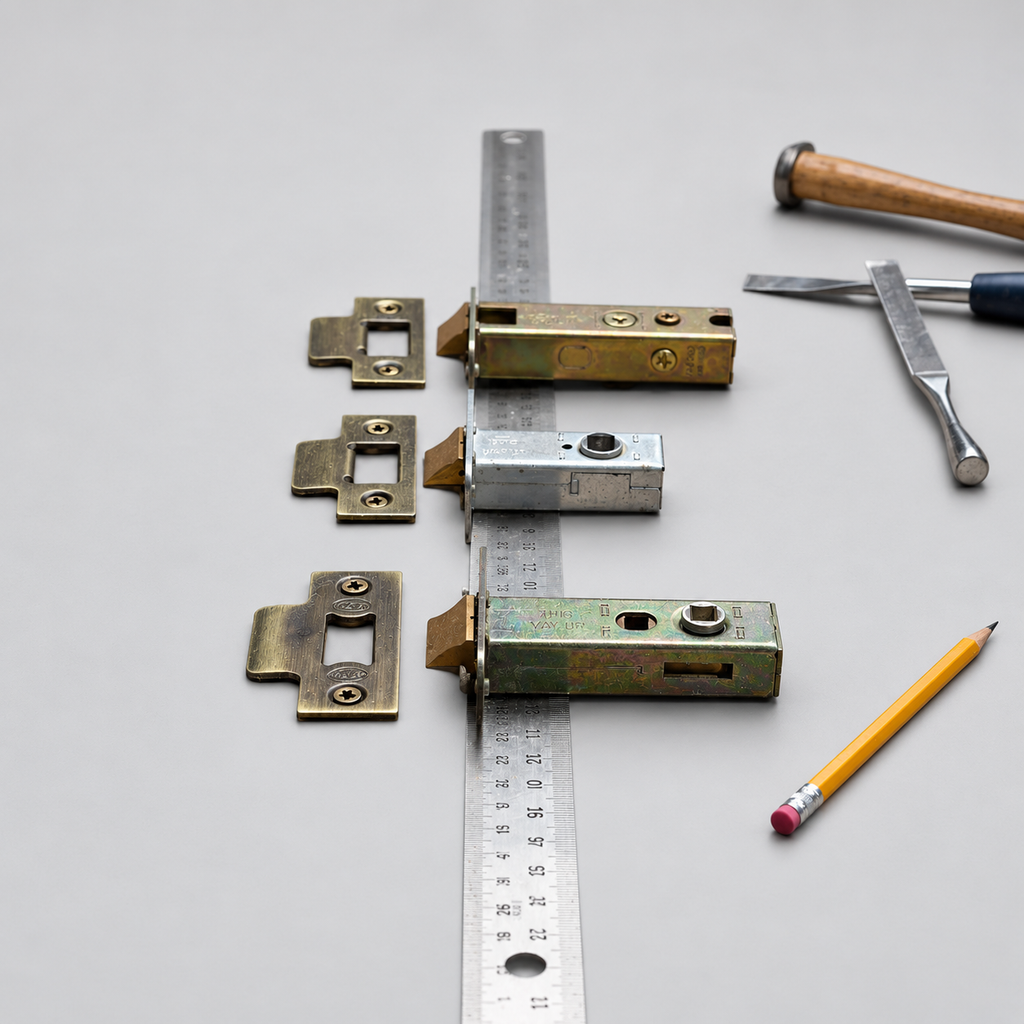
The more difficult question is often not whether a tubular latch is needed, but which size to order.
Customers frequently provide the dimensions of an existing handle or knob when trying to identify a suitable latch. For a replacement, the existing latch itself normally provides more useful information.
Two measurements are particularly important:
- Case length — the overall depth of the latch body inside the door.
- Backset — the distance from the edge of the door or latch faceplate to the centre of the handle spindle.
These measurements are related, but they are not the same thing.
Across relevant Heritage Brass and York Architectural tubular latches, a 2 1⁄2-inch case commonly has a 44mm backset, a 3-inch case a 57mm backset and a 4-inch case an 82mm backset.
Always check the dimensions of the specific product before ordering rather than assuming that the handle dimensions identify the required latch.
What if the latch is for a fire door?
Fire-door hardware needs an additional check: suitability for the required fire performance.
A latch that is appropriate for an ordinary internal door should not automatically be assumed suitable for a fire-door installation.
Check that the specific hardware is suitable for the door’s required fire performance and follow the installation requirements supplied by the door and hardware manufacturers.
What is a sashlock?
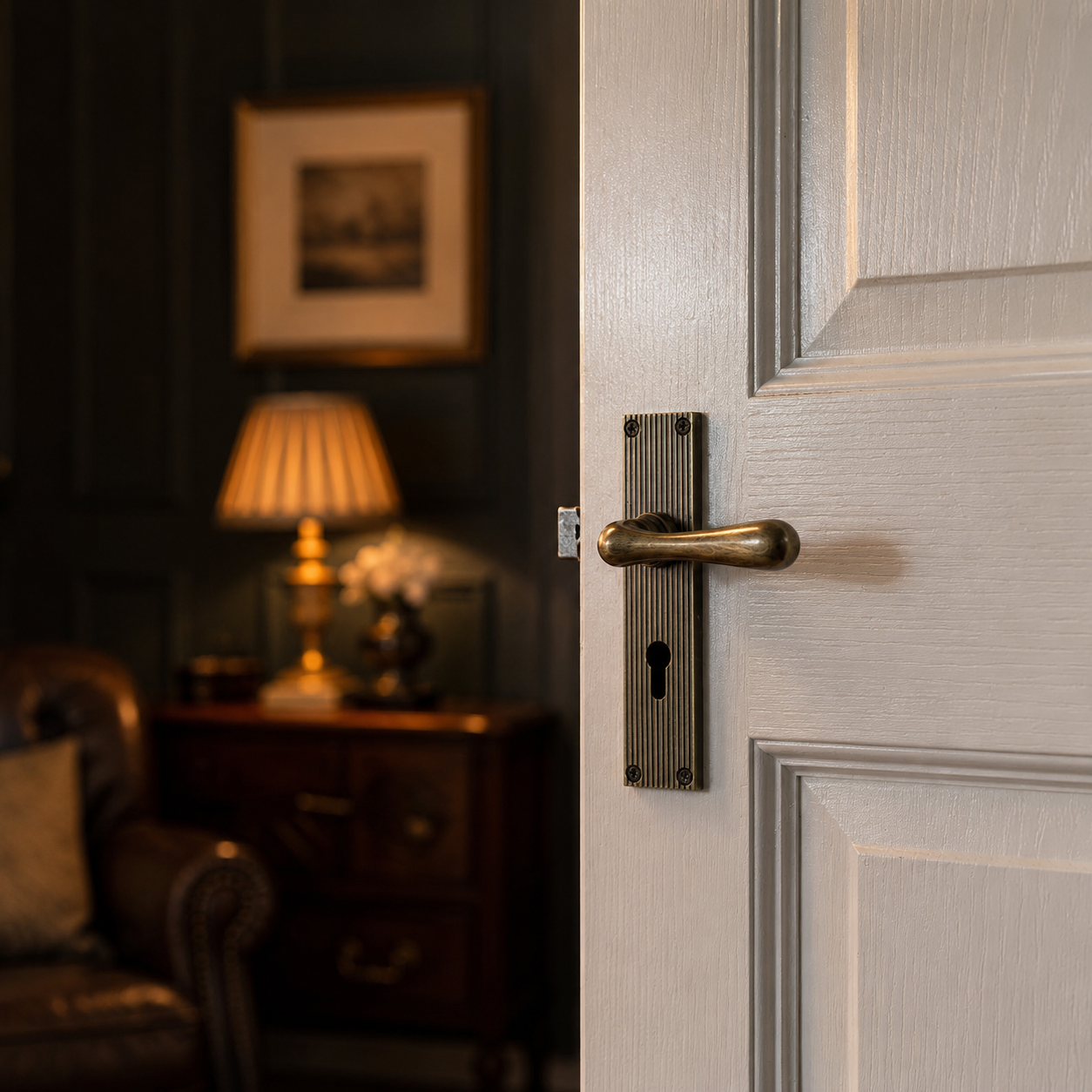
A sashlock combines a sprung latch and a deadbolt within one mortice case.
The latch holds the door closed and is normally withdrawn by the handle. The deadbolt provides the separate locking function and is operated by the appropriate key or cylinder arrangement, depending on the lock design.
This makes a sashlock useful where a door needs ordinary handle operation as well as the ability to be locked.
Sashlocks are also one of the strongest-selling mechanism types among Arrow customers.
Sashlock or tubular latch?
The easiest distinction is the locking requirement.
If the door simply needs to stay closed, a tubular latch may be sufficient.
If the door needs a handle-operated latch and a separate locking function, a sashlock is the more appropriate starting point.
That distinction is particularly useful when door furniture is being selected before anyone has considered what needs to sit inside the door.
Are all sashlocks suitable for external doors?
No. For an external door, the word “sashlock” alone tells you very little about the security level.
Sashlocks are available with different security specifications, so check the individual product, its suitability for the door and any requirements set by the home insurer.
What is a bathroom lock?
A bathroom lock combines normal latch operation with a separate privacy-locking function.
In a typical arrangement, the latch holds the door closed while a bathroom turn or thumbturn operates the privacy bolt.
The door can therefore be locked from inside without requiring the same type of key-operated security normally associated with an entrance door.
Bathrooms are an area where customers frequently need help choosing the right mechanism, particularly when deciding how the handle and privacy control should work together.
Bathroom locks are available in different case sizes and finishes, so the mechanism should be selected alongside the intended door furniture.
Bathroom lock or separate bathroom deadbolt?
These are not the same arrangement.
A bathroom lock combines the latch and privacy-locking function within one lock case.
Another option is to use:
- a normal tubular latch for the handle; and
- a separate tubular bathroom deadbolt operated by a thumbturn and emergency release.
The deadbolt provides the privacy-locking function, while the separate latch continues to operate the handle.
The best arrangement depends on the selected door furniture and how you want the handle and privacy control positioned.
What is a night latch?
A traditional rim night latch is a surface-mounted locking mechanism commonly used on timber entrance doors.
Most of the mechanism sits on the inside face of the door, with access from outside normally controlled through a rim cylinder.
A typical rim night latch latches automatically when the door closes. Different designs can provide different security, snib and hold-back functions.
Night latches are particularly popular with Arrow customers looking for hardware for timber front doors.
Is every night latch suitable for a main entrance door?
No. Security levels vary considerably between night latches. Some provide relatively basic functionality, while others are designed and tested to higher security standards.
Where the lock forms part of the security arrangement for a main entrance door, check:
- the specific security standard;
- compatibility with the door;
- how the night latch works with any additional locks; and
- any requirements imposed by the home insurer.
The product type alone does not establish the required security level.
Deadbolt vs deadlock: what is the difference?
Deadbolt and deadlock are often used as if they mean the same thing, including in customer enquiries.
They are closely related, but there is an important difference.
A deadbolt is the unsprung locking bolt itself or, depending on product terminology, a self-contained bolt mechanism that provides that locking action.
A deadlock is a complete lock whose locking action is provided by a deadbolt but which does not contain the sprung latch found in a sashlock.
A mortice deadlock therefore provides a locking point without also operating as the handle latch.
The distinction is useful when comparing privacy deadbolts with mortice deadlocks, because the word “deadbolt” can refer to both the locking component and particular complete bolt products.
When would you use a deadlock?
A deadlock can be used where a door requires a separate locking point, but the lock itself does not need to operate the handle latch.
One traditional arrangement is a mortice deadlock used as an additional locking point alongside a night latch on a timber entrance door.
The appropriate security arrangement still depends on the particular door, the specification of the hardware and any relevant insurance requirements.
Measure the old lock before replacing it
For a straightforward replacement, start with the lock or latch already in the door.
Matching its main dimensions can reduce the amount of drilling, chiselling or repositioning required.
Depending on the mechanism, useful measurements can include:
- case length or depth;
- backset;
- faceplate dimensions;
- spindle position;
- centres between handle and locking components where applicable;
- door thickness;
- the position of the existing keep.
Do not rely solely on the visible handle or faceplate.
If an exact or close dimensional replacement can be found, much of the existing door preparation may be reusable.
If you are uncertain, photographs of the existing mechanism alongside clear measurements can also make identification easier.
Why finish matching matters
A lock or latch may be primarily functional, but parts of it remain visible after installation.
Depending on the arrangement, these can include:
- the faceplate;
- strike plate;
- key escutcheon;
- thumbturn;
- emergency release;
- surrounding handles or knobs.
Finish mismatch is a recurring reason for exchanges, particularly where customers order a mechanism and later discover that the visible metalwork does not coordinate with the handles or other fittings already installed.
For a replacement or renovation, compare the finish with:
- door handles or knobs;
- hinges;
- cupboard hardware;
- nearby switches and sockets;
- other visible architectural hardware.
This is especially relevant where several products are being coordinated across the same room.
For broader guidance, see our guide to choosing Heritage Brass hardware, door handles and matching finishes.
Do I need to buy the latch or lock separately?
With Arrow’s Heritage Brass range, yes.
The door handle or knob and the operating lock or latch are separate purchases, so the required mechanism should be considered at the same time as the visible door furniture.
Before ordering, check three things:
- Does the door need to latch only or also lock?
- Which operating mechanism provides that function?
- Does the mechanism have the correct dimensions and finish?
That small check can prevent discovering that the handles have arrived but an essential mechanism is still missing.
Common mistakes when choosing locks and latches
Most selection problems occur because the product is chosen before the door function, dimensions and surrounding hardware have been confirmed.
Common mistakes include:
- assuming a handle or knob includes the latch or lock;
- ordering according to handle dimensions rather than measuring the existing mechanism;
- confusing a deadbolt with a deadlock;
- selecting the correct mechanism but the wrong case size or backset;
- changing the lock size unnecessarily during a straightforward replacement;
- overlooking the finish of the visible faceplate or strike plate;
- assuming all locks of the same broad type provide the same security level;
- choosing external-door hardware without checking certification or insurer requirements;
- selecting fire-door hardware without checking suitability for the required fire performance.
A good buying decision should leave you with the right mechanism for the job, dimensions that suit the door and visible hardware that works with the rest of the room.
Door locks and latches FAQs
These questions reflect some of the practical problems that arise when customers choose or replace door hardware. The individual product specification should still be checked before ordering or installation.
What is the difference between a lock and a latch?
A latch holds a door closed and is normally withdrawn using a handle or knob. A lock adds a mechanism that prevents the door from being opened until the locking element is released by a key, thumbturn or other appropriate control.
What is the difference between a sashlock and a deadlock?
A sashlock combines a sprung latch and a deadbolt, so the handle can operate the door normally while the deadbolt provides the locking function.
A deadlock contains the deadbolt without the sprung handle-operated latch.
Is a deadbolt the same as a deadlock?
Not precisely. A deadbolt is the locking bolt or, depending on product terminology, a complete bolt mechanism. A deadlock is a complete lock containing a deadbolt but no sprung latch.
The terms are commonly used interchangeably, which is why checking the actual mechanism matters.
What size tubular latch do I need?
Measure the existing latch where possible.
Check both its case length and backset rather than choosing a replacement solely from the size of the handle or knob.
Do Heritage Brass door handles include a latch?
No. Arrow’s Heritage Brass locks and latches are purchased separately from its door handles and knobs, so the required mechanism should be selected alongside the door furniture.
Is a night latch suitable for a front door?
Rim night latches are commonly used on timber front doors, but security levels vary substantially between products.
Check the specific standard, door compatibility and any requirements imposed by the home insurer before choosing one.
Should I replace an old lock with the same size?
Where the existing arrangement works correctly, matching its dimensions can reduce the need to alter the door.
Measure the existing mechanism first and compare its main dimensions with the proposed replacement.
Choose the function first, then check the door
The names used for door locks and latches can make the category appear more complicated than it needs to be.
Start with the job the door must perform. Decide whether it simply needs to stay closed, provide privacy, lock independently or form part of an entrance-security system.
Then match the mechanism to the existing door preparation and check the dimensions carefully before ordering.
Finally, coordinate the visible parts with the handles, knobs, hinges and surrounding hardware.
That approach is much more reliable than choosing a lock or latch by appearance or product name alone.
Recent Posts
-

Alabaster Lighting: A Guide to Styling Alabaster Lights in UK Homes
Alabaster is a fine-grained, mineral-based natural stone prized for centuries in sculpture and arch …12th Oct 2026 -

What Bulbs Do Chandeliers Use? E14, Lumens, Colour Temperature and Dimming Explained
Choosing a chandelier is only part of the decision. The bulbs still need to fit properly, provide t …3rd Oct 2026 -
Rocker, Intermediate, Fan Isolator and Cooker Switches Explained: What Does Each One Do?
Electrical switches can look very similar on the wall while doing very different jobs. Much of the …22nd Sep 2026