
Fire-Rated and Dimmable Downlights: The Practical UK Guide
Downlights can look like a small ceiling decision, but they affect how a room feels every day. When they are chosen well, they make a space feel clean, calm and easy to live in. When they are chosen badly, the problems usually show up later: light that feels too harsh, patchy coverage, awkward dimming, or fittings that do not suit the room as well as they seemed to on paper.
At Arrow Electrical, we recommend treating downlights as a planning decision before they become a product decision. The more useful question is not usually “which fitting looks best?” but “what does this room need from the light?” Once that is clear, it becomes much easier to choose the right type of fitting without making the whole process feel more technical than it needs to.
This guide is designed to help you make that decision more confidently, whether you are planning a renovation, updating one room, or comparing fitting types before you buy.
Key takeaways
Before getting into formats, compatibility and room choice, it helps to anchor the decision in a few practical principles. These are the points that usually prevent the most common downlight mistakes.
- Fire-rated downlights are mainly about helping maintain ceiling integrity once a cut-out has been made.
- Dimmable downlights only work well when the fitting, lamp or driver, and dimmer are compatible with each other.
- GU10, integrated LED and mini downlights suit different priorities, so there is no single “best” format for every room.
- In bathrooms and similar spaces, IP rating matters alongside fire rating and dimming.
- Visible trim and finish matter more than many people expect, especially in kitchens, hallways and design-led rooms.
Quick answer: what fire-rated and dimmable downlights are, and when they matter
Most people searching for fire-rated, dimmable downlights are really trying to answer two questions at once. The first is whether the fitting is suitable for the space and installation. The second is how the room will actually feel when the lights are on in day-to-day use.
A fire-rated downlight is designed to help maintain the ceiling’s fire performance after a recessed fitting has been installed. A dimmable downlight is designed to work with a compatible dimming setup, allowing the light level to be adjusted rather than fixed at a single brightness.
Those features solve different problems. Fire rating relates to the fitting’s role in the ceiling. Dimming relates to comfort, flexibility and mood. Some rooms will need both; others will place more weight on one than the other.
It also helps to separate the technical filters from the format choice. Some projects call for the flexibility of GU10. Others suit the cleaner look of integrated LED. In smaller or more discreet schemes, mini downlights can make more sense than a standard-size fitting.
Fire-rated explained in plain English
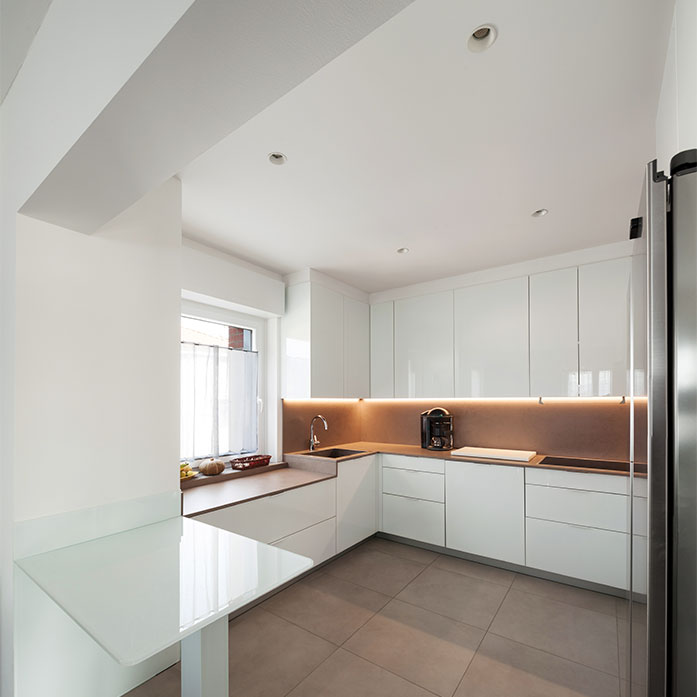
Fire rating can sound more technical than it needs to. In simple terms, once a hole is cut into a ceiling for a recessed fitting, that ceiling may no longer perform in quite the same way as it did before.
A fire-rated downlight is designed to help restore or support that performance. If you are dealing with recessed fittings in a ceiling where fire protection is a consideration, fire-rated downlights are usually the sensible first filter.
That does not mean every fire-rated fitting suits every ceiling or every installation condition, and it does not replace proper installation advice. It does, however, help narrow the field quickly and avoids treating fire protection as an afterthought later in the process.
It is also worth separating fire rating from the other features that are often bundled together in the same conversation. A fitting can be fire-rated and still vary in beam spread, trim style, dimming behaviour, colour temperature and moisture resistance. Fire-rated is one part of the decision, not the whole decision.
GU10 vs integrated LED vs mini downlights
A lot of confusion in this category comes from treating different downlight formats as if one must be universally better than the others. In reality, these formats suit different priorities, and the better choice depends on what you want to control.
| Downlight type | Best for | Main advantage | What to watch |
| GU10 downlights | Renovations where flexibility matters | Lets you choose and change the lamp separately | You still need the right lamp, beam angle and dimming compatibility |
| Integrated LED downlights | Clean, modern schemes with an all-in-one fitting | Neat appearance and simplified fixture design | Dimming compatibility varies by fitting |
| Mini downlights | Smaller ceilings, niches and discreet layouts | Lower visual impact on the ceiling | Not always the best choice for broader general coverage |
GU10 downlights tend to suit people who want more control over the finished effect. If beam angle, lamp warmth or future lamp changes are likely to matter, GU10 can be a practical route.
LED integrated downlights usually suit buyers who want a tidy, self-contained fitting and are happy to choose the performance characteristics up front. They often feel like the cleaner visual choice, particularly in more contemporary interiors where the goal is to keep the ceiling as quiet as possible.
Mini downlights come into their own when scale matters. They can work especially well where a standard fitting feels visually heavy, where the ceiling detail needs to stay subtle, or where the layout benefits from a more refined lighting rhythm.
Dimmable downlights: what actually needs to match
Dimming sounds simple when it appears in a product title, but in real rooms, it is a compatibility question. That is why so many disappointing lighting schemes are not caused by the wrong brightness, but by the wrong combination of fitting, lamp, driver and dimmer.
| Setup | What to check | Common mistakes | Safer approach |
| Integrated LED downlight + wall dimmer | Confirm the fitting is dimmable and check the recommended dimmer type | Assuming any existing dimmer will work | Choose a fitting clearly listed as dimmable and match it with a compatible LED dimmer |
| GU10 fitting + GU10 lamp + wall dimmer | Confirm the lamp is dimmable as well as the dimmer compatibility | Buying a dimmable fitting but a non-dimmable lamp | Use a dimmable GU10 lamp and an LED-friendly dimmer |
| Bathroom or kitchen downlights with dimming | Check dimming, IP rating and room suitability together | Treating dimmability as the only filter | Check the room conditions first, then narrow to dimmable options |
| Mixed fittings on one circuit | Check whether the load and dimmer suit the combined setup | Mixing products with different dimming behaviour | Keep the circuit as consistent as possible |
In day-to-day life, what most people want from dimming is simply more control. A kitchen may need clearer light while cooking and softer light later in the evening. A hallway may feel more comfortable dimmed at night. A living room nearly always benefits from overhead lighting that is not fixed at a single level all the time.
The mistake to avoid is treating dimming as an afterthought. It works better when you decide early whether it matters to the room, then choose the fitting and controls as one joined-up decision.
This is also one of the areas where caution matters. Not every dimmer works with every fitting, and not every LED fitting dims in the same way. If dimming is part of the brief, compare dimmable downlights specifically rather than assuming all downlights in the wider category will behave alike.
Choosing by room: kitchens, bathrooms, hallways and living spaces
Room choice is where downlight selection usually becomes much easier. Instead of asking for the best downlight in the abstract, it is more useful to ask what the room needs from the light and how the fitting will behave in real daily use.
| Room | Good default | Why it works | What to double-check |
| Kitchen | Fire-rated dimmable downlights with practical brightness | Balances task lighting with a softer evening setting | Beam spread, brightness and trim finish |
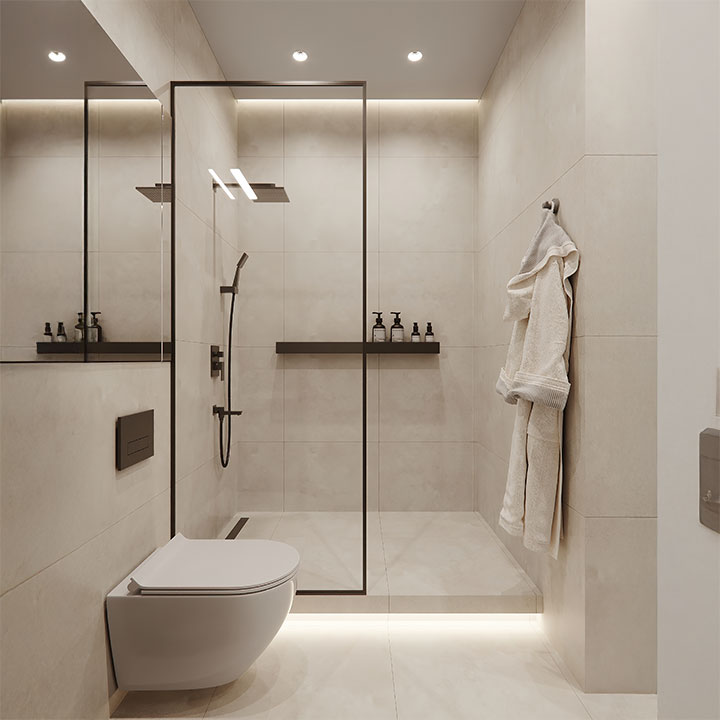
| Bathroom | Fire-rated downlights with an appropriate IP rating | Helps address moisture as well as general suitability | Bathroom zone requirements and dimming compatibility |
| Hallway and landing | Neat, low-profile fire-rated downlights, often dimmable | Keeps circulation spaces clean and evenly lit | Spacing, glare and fitting size |
| Living room | Dimmable downlights with attention to warmth and finish | Gives the room more control and a calmer evening feel | Colour temperature and whether other light sources will support the scheme |
Kitchen
Kitchens usually need a balanced answer rather than the most decorative one. The room needs enough light for prep and everyday use, but not so much harshness that it feels clinical later in the evening.
That is why fire-rated and dimmable fittings often work well here. They provide practical brightness when needed, with the option to soften the room later. This is also one of the spaces where visible trim starts to matter more, especially if the wider scheme includes brass, black or other defined finishes.
Bathroom
Bathrooms are where people most often realise that downlight choice is really a combination of filters. It is not just about style or brightness; you also need to consider moisture resistance and suitability for installation.
This is why IP65 downlights become part of the conversation. In practical terms, the room conditions should narrow the choice first, and only then should you decide how much dimming, visible trim and design detail you want from the fitting.
Hallway and landing
Hallways and landings are often treated as secondary spaces, but they affect how the home feels every evening. A neat, well-spaced scheme can make these circulation areas feel calmer and more considered.
This is also one of the places where mini downlights can make a lot of sense. If the ceiling is prominent, or you want the fittings to disappear as much as possible, a smaller format can work well and usually looks more refined than over-lighting the space.
Living room
Living rooms are usually where dimming proves its value fastest. The room rarely needs a single light level for everything, because cleaning, reading, relaxing, and hosting all require something slightly different from the overhead lighting.
A dimmable scheme with a warmer feel is often the safer route here, particularly when the downlights are only one part of a wider lighting plan that might also include wall lights, table lamps or floor lamps. The aim is not just brightness; it is comfort and flexibility.
Downlight finishes and visible trim: when style starts to matter
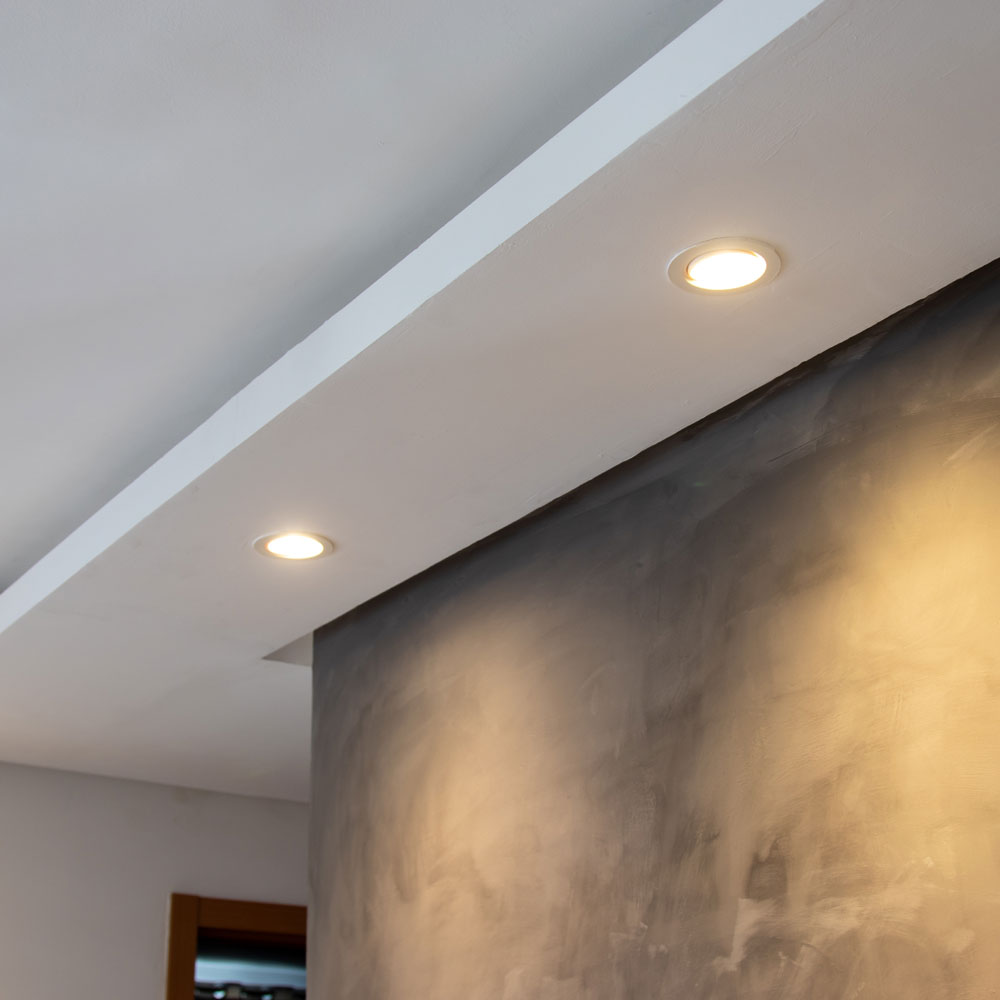
Once the practical filters are in place, the finish becomes the next useful decision. This is where the conversation shifts from pure function into design, because even a discreet downlight still contributes to how the ceiling reads.
In many homes, white remains the easiest default because it allows the fitting to recede into the background. Black can work well when the room already includes darker architectural details. Warm metallic finishes, such as brass, make more sense when the downlight is intended to coordinate with other visible elements rather than disappear completely.
The key is not to choose a finish in isolation. A decorative trim can feel considered in the right kitchen, hallway or living space, but it can also feel random if nothing else in the room supports it. The strongest result usually comes when the finish either steps back deliberately or ties quietly into the room’s wider material palette.
Example downlights worth comparing
Once you know which route feels right, it helps to compare a few specific fittings rather than staying in the abstract for too long. Real product examples also make it easier to see how fire rating, dimming, IP protection and fitting format can combine in different ways.
Example Products:
For a more classic GU10-led route, the Fire Rated GU10 Downlight IP65 – Fixed Trim, Water Resistant is a useful reference.
If you are leaning towards an adjustable integrated fitting, the Fire Rated Downlight Adjustable Dimmable Baffle LED IP65 shows how a more architectural look can still stay practical.
Where a smaller-format fitting makes more sense, the 6W Fire Rated Mini Downlight – Fixed LED, IP65, Dimmable 3000K is a strong example from the mini category.
These are not the only available products, but they are useful reference points because they show how format, fire rating, dimming and moisture resistance come together in slightly different ways.
Fire-rated and dimmable downlights FAQs
A guide like this can raise additional practical questions once the main decision becomes clearer. Below are the most common questions with their answers.
Do all fire-rated downlights dim?
No. Fire rating and dimmability are separate features, so neither automatically guarantees the other. It is important to check whether the fitting is dimmable and, if it uses a separate lamp, whether the lamp is dimmable too.
Are GU10 downlights better than integrated LED downlights?
Not universally. GU10 tends to suit buyers who want more flexibility over the lamp, while integrated LED tends to suit buyers who want a neater all-in-one fitting. The better choice depends on what matters most in the room.
Do I need IP-rated downlights in a bathroom?
Bathrooms often require you to consider IP ratings as part of the selection process, especially in areas with moisture exposure. The right approach is to assess room suitability first, then narrow the choice based on dimming, finishes, and other preferences.
Can I use mini downlights instead of standard downlights?
Yes, where scale and subtlety are part of the brief. They are especially useful when a standard fitting would feel too visually heavy, or when the ceiling detail needs to stay quiet.
Why do LED downlights sometimes flicker on a dimmer?
Usually, because something in the dimming setup isn’t properly matched. The fitting, lamp, driver, and dimmer need to be compatible for dimming to feel smooth rather than erratic.
Is fire-rated the same as bathroom-rated?
No. Fire rating and IP rating refer to different things. In some rooms, especially bathrooms, you may need to think about both together rather than assuming one covers everything.
Explore downlights with more confidence
The best downlight decisions usually come from getting the format right first, then checking the room-specific details properly. Once you know whether you need flexibility, a cleaner, integrated look, a smaller fit, moisture resistance, or dimming control, finding fire-rated, dimmable downlights becomes much easier.To browse the wider category in one place, explore our downlights range.
Recent Posts
-

Fire-Rated and Dimmable Downlights: The Practical UK Guide
Downlights can look like a small ceiling decision, but they affect how a room feels every day. When …8th Apr 2026 -
Switches and Sockets for Renovations: Layout, Finish and Function (Without Regrets)
Switches and sockets are the renovation choices you’ll notice every day. When they’re well planned, …23rd Mar 2026 -
Garden Spike Lights: A Simple Planning Guide for Modern Outdoor Lighting
Garden spike lights are one of the easiest ways to make an outdoor space feel considered after dark …23rd Mar 2026