
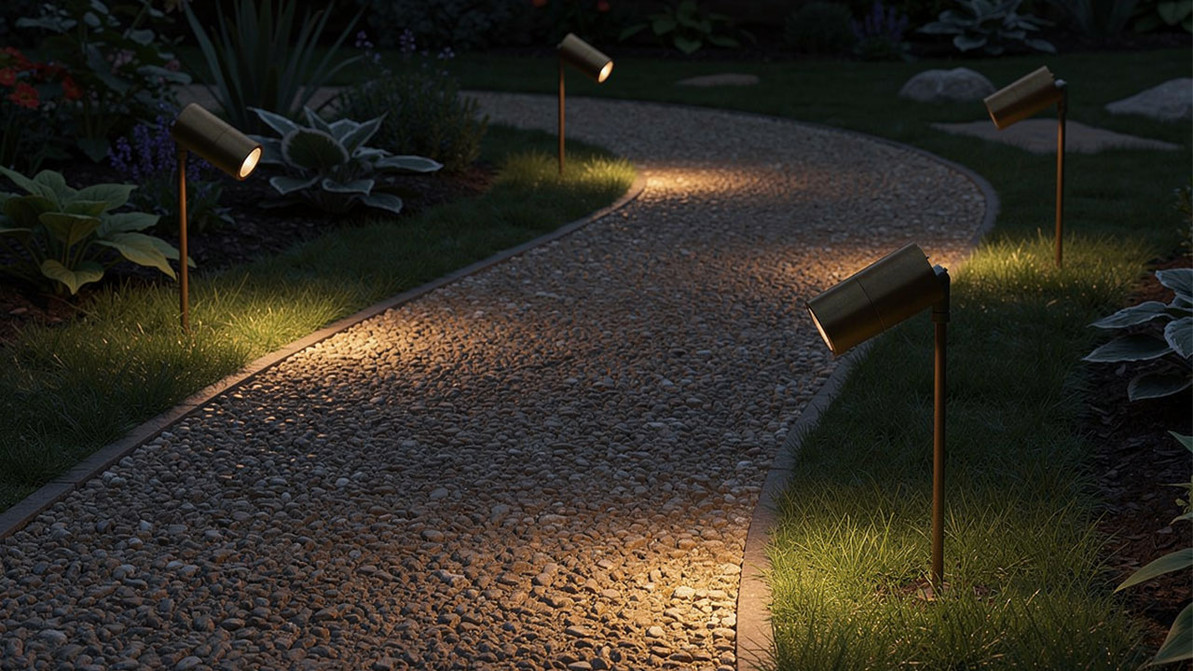
Exterior Spike Lights: Where to Place Them for a Calmer, More Considered Garden
Exterior spike lights can do a lot for a garden without asking for much visual attention. Used well, they add depth, bring out texture and help the space feel more settled after dark, all without filling it with obvious fittings or harsh pools of light.
At Arrow Electrical, we think the most successful spike-light schemes usually start with restraint. A garden does not need every border, shrub and corner lit up to feel finished. More often, it needs a few carefully chosen points of light, aimed properly, with the right warmth and just enough brightness to guide the eye.
This guide is here to help you make those decisions with a little more confidence, whether you are lighting a small patio garden, a planted border, or a larger outdoor space that needs more structure at night.
Key takeaways
Before you start choosing fittings, it helps to anchor the scheme around a few simple planning principles. These are usually the decisions that make the difference between a garden that feels calm and one that feels overdone.
- Start by deciding what needs to be lit first: features, edges, or navigation.
- Use fewer fittings than you think and refine the aiming once it gets dark.
- Warm light usually looks more natural in UK gardens than cooler light.
- If you choose GU10-compatible spike lights, bulb choice shapes the final result just as much as the fitting itself.
Quick answer: What spike lights are best for
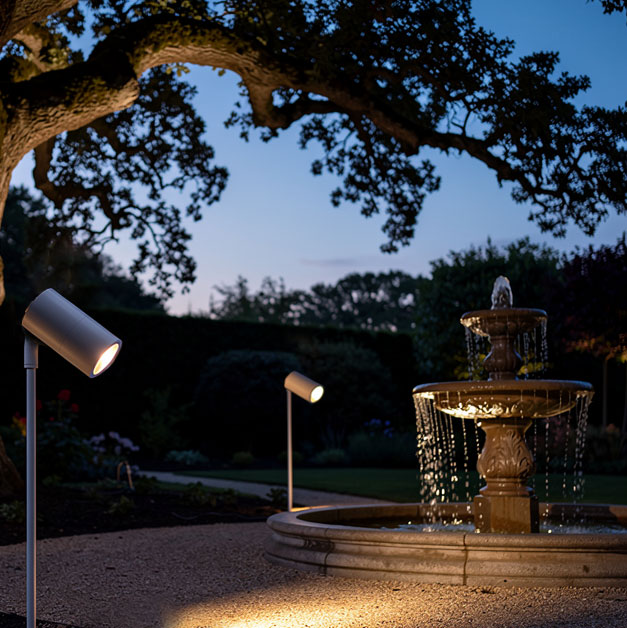
Exterior spike lights are best for directional outdoor lighting. They are particularly useful when you want to highlight planting, skim across a textured wall, pick out the shape of a tree, or gently guide movement along a path or border.
They are less useful when the job is broad, even coverage across the whole garden. In those situations, wall lights, bollards or other outdoor lighting options may do the heavy lifting, either on their own or alongside spike lights.
If the goal is atmosphere, depth and a more considered look after dark, spike lights are often the smarter option. The trick is not to use them everywhere, but to use them where they will actually change how the garden feels.
What to light first: the 3-zone method
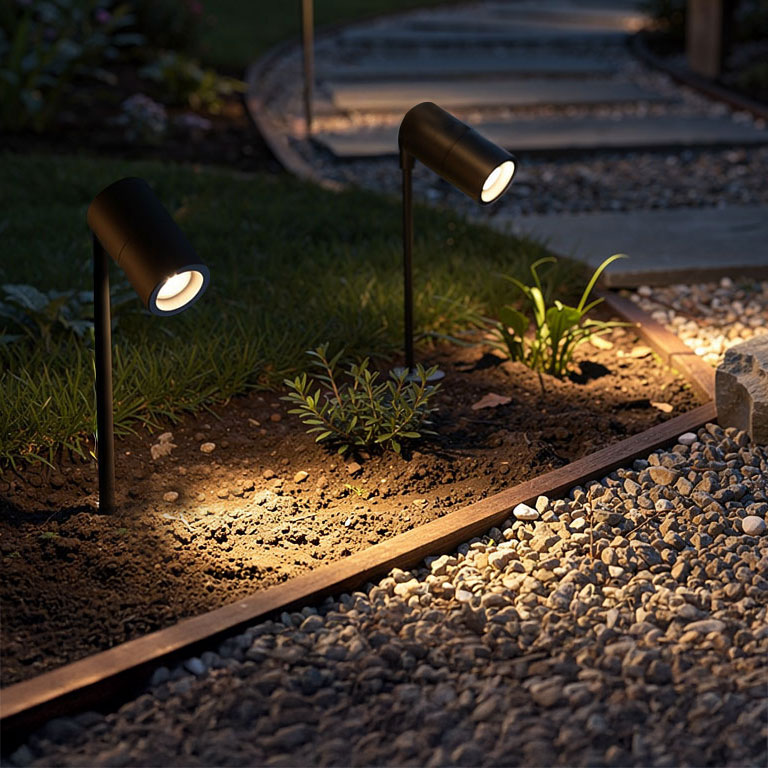
A garden scheme becomes much easier to plan when you stop thinking in terms of fittings and start thinking in terms of layers. One of the simplest ways to do that is to divide the space into three zones: features, edges and navigation.
That keeps you from placing lights wherever there happens to be space in the border. Instead, you place them where they add shape, clarity or atmosphere.
Features
This is the focal-point layer. It might be a small tree, a sculptural planter, a textured wall, or a section of planting you want to notice from the house or patio. In most gardens, one or two well-lit features will do more than trying to illuminate everything evenly.
Edges
This is the structure layer. Lighting the edge of a border, fence line, or bed helps define the shape of the garden after dark. It also stops the whole space from collapsing into one flat dark mass once the daylight goes.
Navigation
This is the practical layer. Paths, level changes and steps need enough light to feel readable and safe, but not so much that the fittings become the thing you notice first.
A good working rule is to begin with one fitting or small cluster in each zone, then add only where the garden still feels visually incomplete.
Spacing and aiming rules
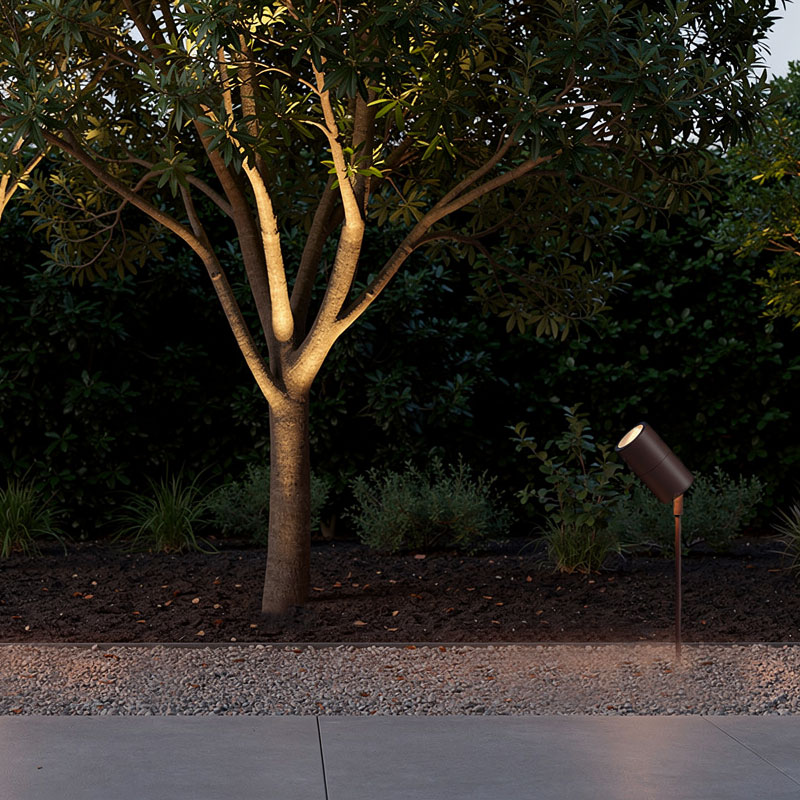
Most disappointing garden lighting is not the result of choosing the wrong fitting. It usually comes down to aiming, spacing, or exposing the light source too directly.
Arrow Customer Insight: According to our support feedback, one of the primary reasons spike lights are recommended over fixed ground-lights is their low risk of error, because you can adjust their aim and position at any time. Homeowners rarely experience ‘buyer’s remorse’.
As a general rule, hide the fitting where you can, usually in planting or low beds, and aim the beam across a feature rather than back towards the viewer. In most cases, it is more effective to light a surface, trunk or canopy than to let the fitting itself become the focus.
| What are you lighting | Where to place the fitting | What you want to see |
| Path edge | In planting just off the route | A soft wash across the ground |
| Feature plant | Slightly behind or to the side | Shape and leaf texture |
| Tree or shrub | Further back than you think | Height and depth, not a hotspot |
| Fence or wall | Low and close to the surface | Texture and gentle shadow |
| Steps | Off to the side, low down | Safer footing without glare |
If a spike light feels glaring, the cause is usually one of three things: the beam is too narrow, the fitting is too exposed, or the aiming angle is too high.
Warm vs cool outdoors: what looks natural in UK gardens
Colour temperature changes the mood of a garden more than many people expect. In residential settings, warmer light usually feels softer, more flattering and more natural, especially around planting, seating and outdoor dining areas.
Cooler light can work where clarity matters more than atmosphere, such as side access routes or utility zones, but it can also make planting, stone, and timber feel harder if it is overused.
| Colour temperature | Effect | Best placement |
| 2700K | Very warm, soft, atmospheric | Seating areas, feature planting and intimate corners |
| 3000K | Warm but slightly cleaner | Most garden schemes, borders, patios and paths |
| 4000K | Crisper, more functional | Utility routes, side passages and task-led areas |
For most gardens, 3000K is the safest all-round choice.
Arrow Trade Insight: Our sales data consistently shows that the vast majority of landscape contractors default to 3000K (warm white) fittings over cooler alternatives to maintain a softer, more natural garden atmosphere. If you want a softer, more intimate feel, 2700K can work beautifully, particularly in smaller or more sheltered spaces.
GU10 spike lights: choosing beam angles and brightness
If you choose GU10-compatible spike lights, the bulb becomes part of the design rather than just a technical detail. That can be useful, because it gives you more control over beam angle, brightness and colour temperature.
For most residential accent lighting, the aim is not obvious brightness. It is shape, depth and a more layered view of the garden. That is why lower-output lamps often work better than people expect.
| Beam angle | What it does | Best use |
| Narrow | Creates a tighter, more dramatic pool | Feature plants, small trees, sculpture |
| Medium | Balances focus with some spread | Borders, shrubs, mixed planting |
| Wide | Spreads light more evenly | Wall washing, broader beds, gentle edge lighting |
If you want that extra flexibility, it makes sense to choose GU10-compatible fittings first and then compare GU10 bulbs by beam type and warmth.
Arrow Trade Insight: Our trade desk reports that GU10-compatible fittings remain the most popular choice for UK garden lighting due to their flexibility, which allows users to swap beam angles to suit specific trees or features easily.
Example spike lights worth comparing
Once you know the kind of effect you want, it helps to compare a few fittings rather than staying in the abstract. Product examples are useful here because they show how size, bulb type and fitting style can shift the feel of a scheme.
For a simple GU10 option, the IP65 Garden Spike Light – Adjustable Head, GU10 Compatible is a useful reference for borders and general directional lighting.
If you want something with a little more reach, the Outdoor Long Garden Spike Light – Adjustable Head, IP65 is a good example of the same GU10-led flexibility scaled for larger planted areas.
For an integrated LED alternative, the 5W IP65 Adjustable Spike Garden Light 3K shows the appeal of a simpler all-in-one fitting.
IP ratings outdoors: what IP65 means in practice
Outdoor fittings need to cope with rain, splashes and general exposure. In practical terms, IP65 is a sensible baseline for many spike lights because it offers good protection against dust and water jets.
That does not mean every IP65 fitting is automatically right for every position, but it does mean you are starting from the level of weather resistance most homeowners would expect for exposed garden lighting. If you are unsure, treat IP rating as a basic planning filter and confirm final installation details with a qualified electrician. Arrow’s current spike-light range includes weatherproof garden spike lights with IP65 and IP66 ratings.
Exterior spike lights FAQs
Once people start planning a garden properly, the same practical questions tend to come up. These are usually the ones that decide whether the finished scheme feels balanced or overworked.
How many spike lights do I need?
Usually fewer than you think. Start with one focal feature, one edge-defining area, and one navigation need, then add only if the garden still feels visually incomplete.
Where should exterior spike lights go?
They usually work best tucked into planting or low beds, angled across a feature or surface rather than pointed directly at people. Final aiming should always be checked at night.
What is the best colour temperature for outdoor lighting?
For most residential gardens, 3000K is the safest starting point. It feels warm, natural and calm without becoming too amber or too clinical.
What beam angle is best for spike lights?
That depends on what you are lighting. Narrow beams suit focal features and drama, while wider beams work better for softer washes across planting or surfaces.
What does IP65 mean for outdoor lights?
In practical terms, it means the fitting is designed to cope with typical outdoor exposure. It is a strong baseline for many garden spike-light applications, though installation and placement still matter.
Explore garden spike lights
The most convincing outdoor lighting schemes rarely come from adding more fittings. They usually come from placing a few lights with more purpose, aiming them properly, and choosing a warmth that supports the garden rather than fighting with it.
If you want to compare fittings for a calmer garden scheme, explore our garden spike lights range. Arrow’s current collection covers waterproof GU10 and integrated LED options for borders, pathways, plants, and feature lighting.
Recent Posts
-
What Bulbs Do Chandeliers Use? E14, Lumens, Colour Temperature and Dimming Explained
Choosing a chandelier is only part of the decision. The bulbs still need to fit properly, provide t …3rd Oct 2026 -
Rocker, Intermediate, Fan Isolator and Cooker Switches Explained: What Does Each One Do?
Electrical switches can look very similar on the wall while doing very different jobs. Much of the …22nd Sep 2026 -
How Many Downlights Do You Need? Plan the Layout Before You Install
Downlights are often arranged on a ceiling before anyone has asked the most important question: what …10th Sep 2026