
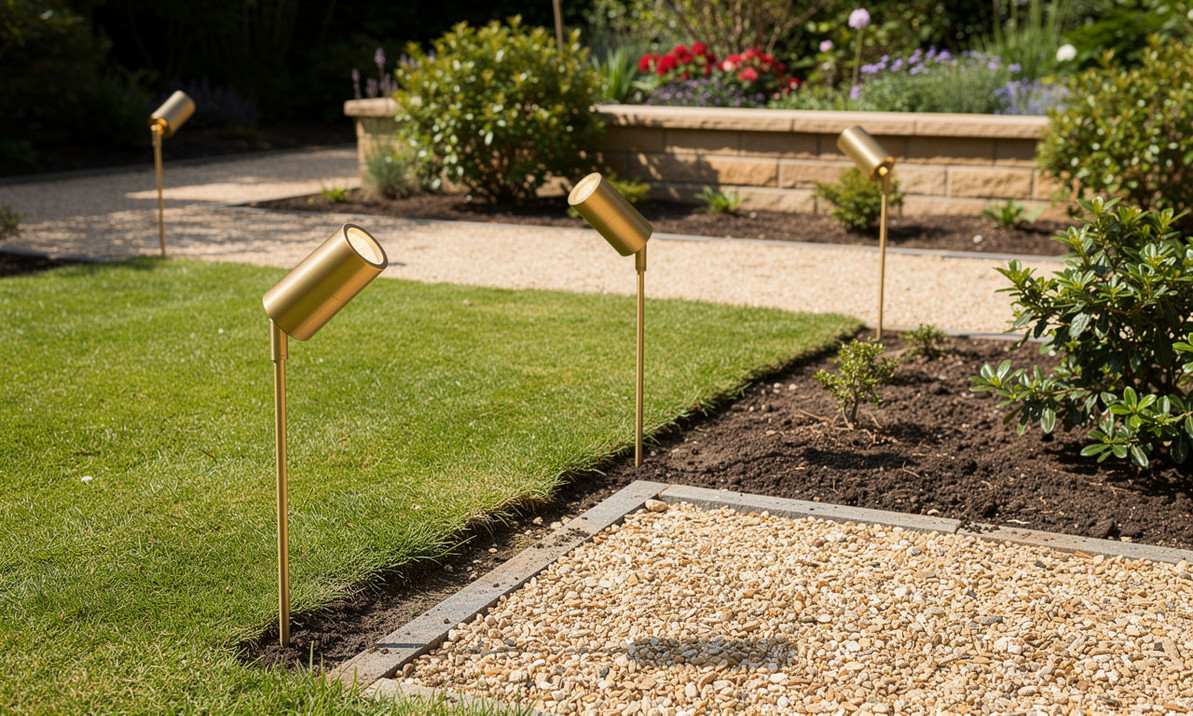
Garden Spike Lights: A Simple Planning Guide for Modern Outdoor Lighting
Garden spike lights are one of the easiest ways to make an outdoor space feel considered after dark. Used well, they highlight shape, texture and movement in the garden without filling the space with visible fittings or overly bright light.
At Arrow Electrical, we recommend thinking about spike lights as a planning decision before they become a product decision. The best schemes are usually the simplest: a few well-placed fittings, aimed carefully, with warmth and brightness chosen to support the garden rather than overpower it.
Key takeaways
This guide is designed to help you plan a calmer, lower-glare outdoor scheme. If you only remember four things, make it these.
- Start by deciding which needs to be lit first: features, edges, or navigation.
- Use fewer fittings than you think and refine the aiming once it gets dark.
- Warm light usually looks more natural in UK gardens than cooler light.
- If you choose GU10 spike lights, beam angle and bulb choice will shape the final result just as much as the fitting itself.
Quick answer: what spike lights are best for (and what they are not)
Garden spike lights are best for directional outdoor lighting. They work particularly well when you want to highlight planting, skim across textured surfaces, or guide you as you walk along a path or border.
If you need broader, more even coverage, spike lights may not be the best standalone solution. In those cases, path lights, bollards, wall lights, or downlights can work well either in place of spike lights or alongside them, depending on whether the priority is navigation, general ambience, or feature lighting.
If your aim is atmosphere, depth and gentle wayfinding, spike lights are often the smarter option. However, if you’d like to see the broader category around them, you can also explore our extended outdoor lighting range.
What to light first: the 3-zone method
A good garden scheme becomes much easier when you divide the space into three simple zones. This helps you avoid the common mistake of placing fittings wherever there happens to be room, rather than where light actually adds value.
Features
This is your focal-point layer: a feature tree, a sculptural planter, a textured wall, or a border you want to notice from the patio or indoors. Usually, one or two well-lit features do more for the garden than evenly lighting everything.
Edges
This is the structure layer. Lighting the edge of a bed, fence line, or border helps define the shape of the garden after dark and prevents the whole space from disappearing into a single dark mass.
Navigation
This is the practical layer. Paths, level changes and steps need enough light to feel safe and readable, but not so much that the fittings become glaring reference points themselves.
A useful rule is to plan one fitting or cluster per zone first, then add only where the garden still feels visually incomplete.
Spacing and aiming rules
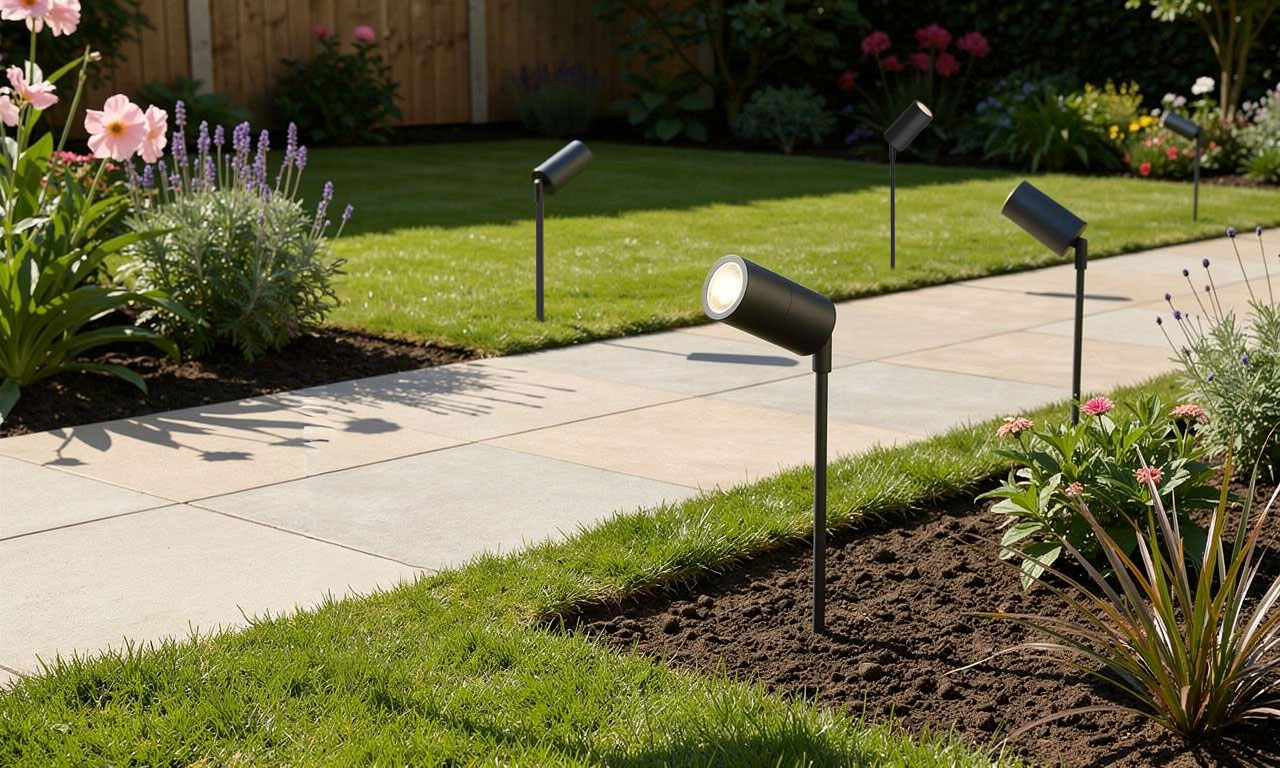
Most disappointing garden lighting is not the result of the wrong fitting — it is the result of poor aiming. This is where a scheme either starts to feel calm and expensive, or harsh and overdone.
Start by hiding the fitting where possible, usually in planting or low beds, and aim the beam across the feature rather than towards the viewer. In most cases, it is better to light a surface, a trunk, or a leaf canopy than to expose the source itself.
A practical placement guide:
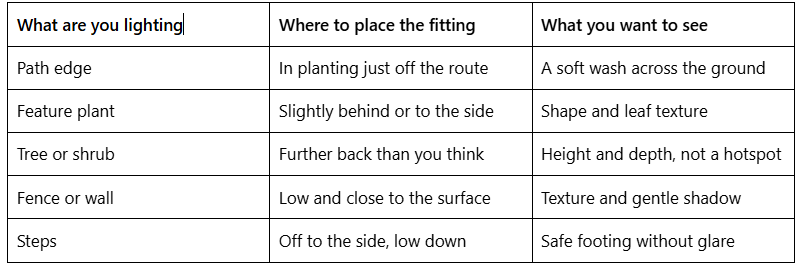
If a garden light feels dazzling, the cause is usually one of three things: the beam is too narrow, the fitting is too exposed, or the aiming angle is too high.
Warm vs cool outdoors: what looks natural in UK gardens
Colour temperature can change a garden’s mood more than many people expect. In residential settings, warmer light tends to feel more natural and more forgiving, especially around planting and seating areas.
Cooler light can work where clarity is more important than atmosphere, such as side access routes or practical utility zones, but it can also make timber, planting and stone feel harder if overused.
A simple warmth guide:
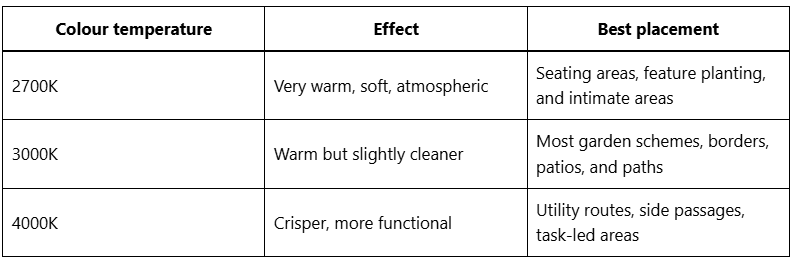
If you want a softer, more wildlife-friendly scheme, it can also be worth considering very warm lighting. In practice, 3000K remains a strong all-rounder for most gardens, while 2700K can work well for a more intimate, lower-impact feel.
GU10 spike lights: choosing bulb beam angles and brightness
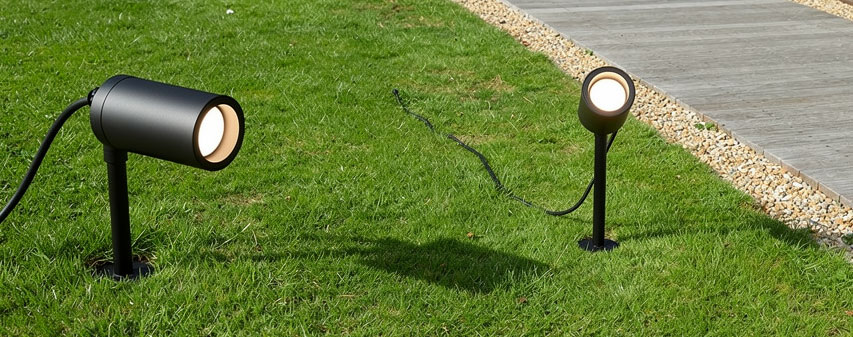
If you choose GU10-compatible spike lights, the bulb choice becomes part of the design. That is useful, because it gives you more control over beam angle, brightness and colour temperature.
However, brightness matters just as much as beam angle. For most residential accent lighting, the goal is to create shape and depth rather than obvious brightness, so lower-output lamps often work better than people expect.
A narrower beam usually works best when you want to highlight one plant, trunk or object. A wider beam is usually better when you want a softer wash across a bed or low planting area.
A simple beam-angle guide:
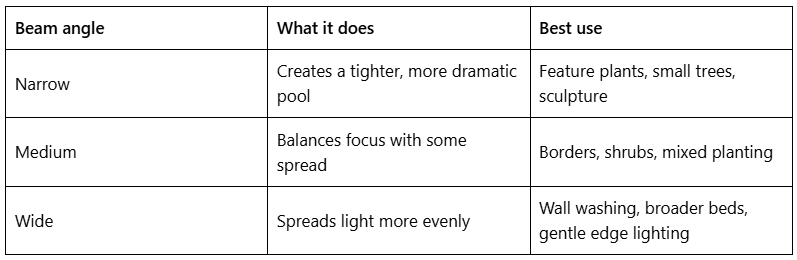
If you want a fitting that gives you bulb flexibility, see these GU10-compatible spike lights within the spike lights range, and compare bulb options here: GU10 bulbs for spike lights
Example spike fittings you can use as reference points:
- Outdoor garden ground spike light, IP65, GU10 compatible</a>
- Dartmouth spike spotlight, textured black, GU10 compatible.
IP ratings outdoors: what IP65 means in practice
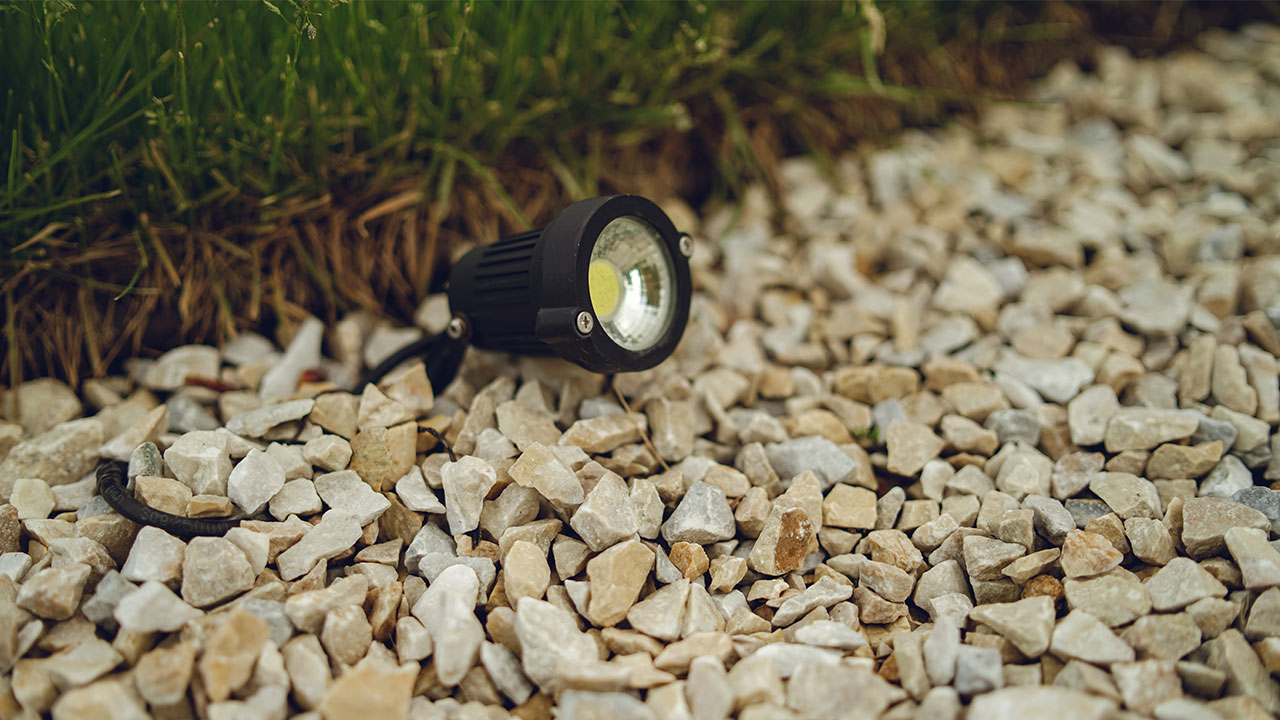
Outdoor fittings need to withstand weather, splashes, and general exposure. In practical terms, IP65 is a common and sensible baseline for many garden spike lights because it offers good protection against dust ingress and water jets.
That does not mean every IP65 fitting is suitable for every possible outdoor scenario, but it does mean you are starting from the level of weather resistance most homeowners expect for exposed garden lighting. If you are unsure, treat IP rating as a minimum planning filter and confirm installation details with a qualified electrician.
For a simple integrated LED example, you can look at: Adjustable 5W black LED garden spike light, IP65.
Garden spike lights FAQs
These are the questions people usually ask once they start garden planning. They are also the questions that tend to separate a calm lighting scheme from one that feels overdone.
How many spike lights do I need?
Usually fewer than you think. Start with one focal feature, one edge-defining area and one navigation need, then add only if the scheme still feels incomplete.
Where should garden spike lights go?
They usually work best tucked into planting or low beds, angled across a feature or surface rather than pointed towards people. Final aiming should always be checked at night.
What is the best colour temperature for outdoor lighting?
For most residential gardens, 3000K is the safest starting point. It feels natural, flattering and calm without looking too warm or too clinical.
What beam angle is best for spike lights?
That depends on what you are lighting. Narrow beams suit features and drama; wider beams suit softer, broader washes across planting or surfaces.
What does IP65 mean for outdoor lights?
In practical terms, it means the fitting is designed to withstand typical outdoor exposure. It is a strong baseline for many garden spike light applications, though installation and placement still matter.
Shop garden spike lights
The best outdoor schemes usually come from a simple plan, careful aiming and the right level of warmth. If you want to compare fittings and build a scheme that feels calm rather than overlit, view our garden spike lights range.
If you are choosing GU10-compatible fittings and want more control over beam angle and colour temperature, see our GU10 bulbs range.
Recent Posts
-
Switches and Sockets for Renovations: Layout, Finish and Function (Without Regrets)
Switches and sockets are the renovation choices you’ll notice every day. When they’re well planned, …23rd Mar 2026 -
Garden Spike Lights: A Simple Planning Guide for Modern Outdoor Lighting
Garden spike lights are one of the easiest ways to make an outdoor space feel considered after dark …23rd Mar 2026 -
The Garden After Dark: How 2026 Is Redefining Outdoor Lighting with Garden Spike Lights
By 2026, the most impressive gardens aren’t the brightest ones; they’re the quietest. Instead of fl …9th Feb 2026